
AI answers are now part of how people search. Pew Research found that 18% of Google searches in its March 2025 study produced an AI summary, and people who saw one clicked a regular result in 8% of visits, compared with 15% when no summary appeared. More of the decision now happens inside the answer.
Getting your business named in those answers is called AEO, short for answer engine optimization. It just means making your business easy for ChatGPT, Google AI Overviews and similar tools to find, understand and recommend. The question we hear most from owners is simple: can I do AEO in house, or do I need to hire someone? The honest answer is that an owner can handle more of it than most people expect. Here is what an owner can handle, and where doing it yourself runs out of road.
Can you do AEO in-house? Mostly, yes
Yes, a home service owner can do most of the foundation of answer engine optimization in-house. Google says plainly that there are no additional requirements to appear in AI Overviews or AI Mode, nor other special optimizations necessary. A page has to be indexed and eligible to show in regular search. Google’s advice from there is familiar: useful text, a good page experience and an up-to-date Business Profile.
That matters because a lot of AI search advice is sold as a new, mysterious skill. For a local service business, most of it is the same groundwork as good local SEO. AEO and SEO are not rivals, and Google’s own AI answers only link to pages that already qualify for regular search. AI tools lean on your profile, your reviews, your website and what other sites say about you. We explained that picking process in how AI decides which local business to recommend, so we will not repeat it here.
For a four-truck company, “in-house” does not mean hiring a marketing team. It means you or your office manager, a few focused hours to start and two to four hours a month after that. The basics are not hard. They are just easy to put off.
The AEO work an owner can handle in one afternoon
Block off one afternoon and work through the pieces AI reads first. Google says businesses with complete and accurate information are more likely to show up in local results, and AI answers draw on the same profile. Start there, then work outward.
- Finish your Google Business Profile. Pick the most accurate primary category, list every service you actually offer, set real hours and a true service area, and add recent photos of your own trucks and crew.
- Match your details everywhere. Check that your business name, address and phone number read the same on your website, your profile, Yelp, Facebook and the BBB.
- Fix your About page. Use real names, how long you have been in business, the towns you serve and any license numbers your trade requires.
- Put your services on your site in plain words. If your profile lists drain cleaning and water heater repair, your website should say the same thing in the same words.
- Ask five recent customers for a review. Ask them to mention the job and the town, which gives AI real words to repeat about you.
None of this needs a tool or a login beyond the ones you already have. It is unglamorous work, and that is exactly why so many of your competitors have not done it.
Monthly habits that keep your AI visibility growing
After the afternoon, AEO in-house becomes a short monthly routine. Keep asking for reviews after good jobs. Add new photos. Take one question you heard on the phone this month, like “do you charge extra on weekends” or “how fast can you get here,” and answer it plainly on the matching page of your website. Over a year, that steady trickle of helpful content adds up.
Then run a ten-minute check. Ask ChatGPT, Google and Perplexity the questions your customers ask, such as “best plumber in my town” or “best HVAC company open on Sunday near me.” Write down which businesses get named, whether you are one of them and whether the answer shows a citation link to your website. Do it from your phone, the way a customer would, once a month.
One warning from running these checks for our own clients. The same question can get a different answer from one day to the next, and each tool has its own favorites. A single answer tells you very little. Three or four months of notes tell you whether you are showing up more often, which is the only thing that matters.
Where doing AEO yourself stops working
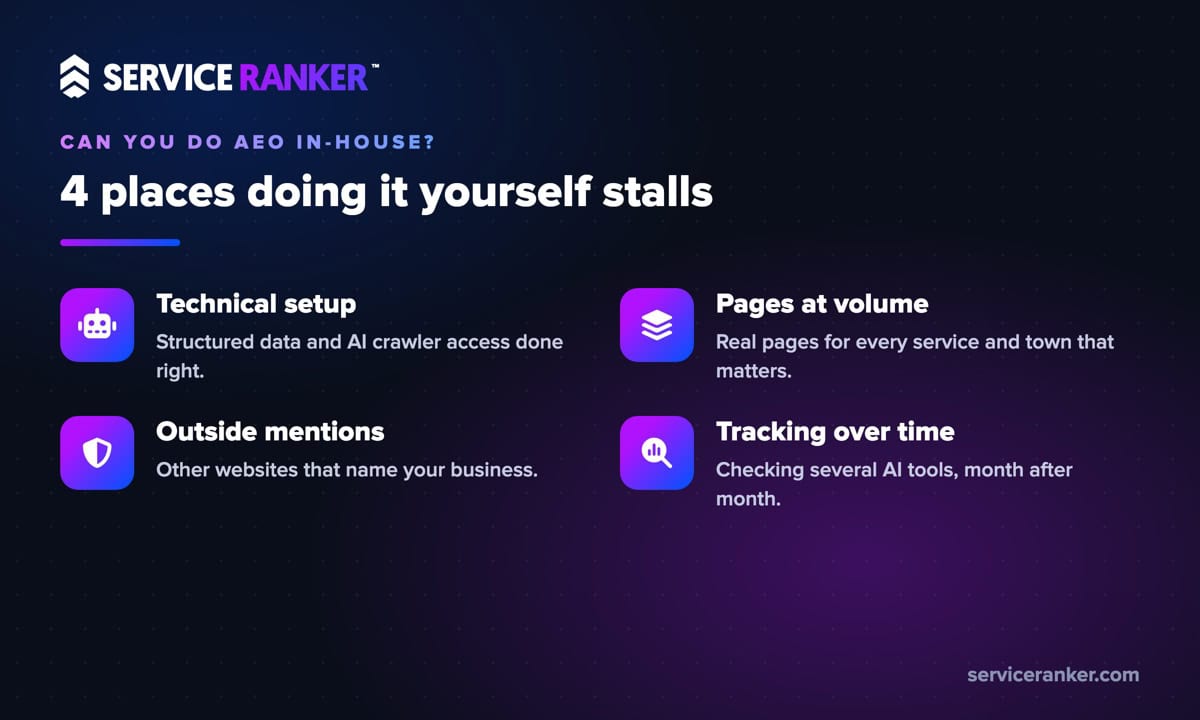
Doing AEO yourself usually stalls in four places: the technical setup behind your website, the number of pages it takes to cover every service and town, getting other websites to mention you, and tracking AI answers across several tools over time. None of these is a secret. They take hours, know-how and repetition that most owners do not have to spare. It is rarely a strategy problem. It is a time problem.
The technical side is where well-meaning owners get stuck first. Structured data, the behind-the-scenes labels that tell machines what your business is, has to match the visible text on the page, which Google calls out in the same guidance. AI crawlers also need to be allowed in. OpenAI says sites should allow OAI-SearchBot in robots.txt to appear in ChatGPT search. A security plugin or firewall setting can block that without anyone noticing.
Then comes volume. AI citations tend to point to the specific page that answers a question, which we covered in the website details that decide whether AI can read your business. A company with eight services and fifteen towns needs real pages for the combinations that matter, written so they are not copy-paste templates. That is a content job measured in months, not afternoons. Outside mentions take steady effort too: local news, trade associations, suppliers and community sites that name your brand and link to you.
This is the half of the work our AI search optimization for home service businesses is built around. Not because an owner cannot learn it, but because it rarely fits next to running crews, quotes and payroll.
Mistakes that make in-house AEO look like it failed
Most in-house AEO does not fail. It stops halfway and gets blamed. The most common version is companies finishing the profile and reviews, skipping the pages they still need to build, and deciding AI search does not work. The first half gives AI a reason to trust you. The second half gives it something to quote.
The second mistake is reacting to one answer. An owner sees a competitor named on Tuesday and rewrites the homepage on Wednesday. Give changes a few months and judge them by your monthly notes, not a single screenshot.
The third is buying an AI visibility tool before the basics are done. Tracking tools measure your AI visibility. They do not fix anything. A dashboard full of missing mentions only helps if someone has the time to act on it. The last is stuffing keywords into questions and answers on your site. AI tools want a clear answer a person would give, not “best plumber near me” repeated six times.
In-house or agency, how to decide
Three questions settle it for most owners. First, can someone on your team give this two to four steady hours a month, every month? Second, after 90 days of monthly checks, are you showing up more often than when you started? Third, how many service and town pages are still missing from your site?
If the hours are there, your name is appearing more often in ChatGPT and Google answers and the page list is short, keep doing it yourself. That is a real result, and no agency should talk you out of it. If the hours keep slipping, the checks are flat after the basics are done, or the missing pages run into the dozens, that is the point where an agency earns its keep. The real cost of doing it yourself is not money. It is the hours that come out of running the business. If you do hire an AEO agency, ask to see those monthly checks, not just a dashboard.
Either way, start with the afternoon list. It costs nothing but time, and it makes any help you hire later more effective. If you get there and want a partner for the rest, we can take the time-heavy half of AI search off your plate. You run the jobs, we keep the calls coming.