
By mid-November, most moving companies feel it. The summer rush is a memory, the crew is asking about hours, and the trucks sit in the yard more days than they roll. Every mover knows the moving company slow season is coming, and it usually runs from late fall through February. The question is what to do with it.
Here’s the short answer. The winter jobs that still exist are urgent and tied to a fixed date. Movers win them by staying easy to find for those searches, answering every call fast, and working the people who hear about winter moves first. There are fewer moves, and each one takes more effort to land. That’s the long haul of the holiday lull, and the companies that plan for it come out the other side in better shape than the ones that just wait for spring.
How slow the moving slow season really gets
Ask most people the best time of year to move and they’ll say summer. Moving demand bunches up then and thins out in winter, but it never stops. A U.S. Census Bureau study of when people moved found that June alone accounted for 12 percent of moves and 41 percent happened from May through August. After August the share dropped month by month, with the lowest stretch from December through February, when the report notes winter weather makes moving harder and children are in school.
Here’s the part owners tend to miss. In the study’s 2004 survey, winter still held 20.7 percent of moves. That’s roughly 1 in 5 moves happening in the months most movers write off. Summer held 32.2 percent, so winter is slower, not empty.
The data are older, from survey panels that ran from 1993 to 2004, but the pattern held across every panel the Census Bureau looked at. Where you operate matters too. People in the Northeast and Midwest were more likely to have moved in summer (34 and 33 percent) than people in the South (31 percent) and West (32 percent). A mover in Texas or Arizona may feel a softer lull than one in Ohio.
Who still moves between Thanksgiving and New Year’s
Winter customers rarely move because the timing is nice. They move because something forced a date. Nobody picks the week before Christmas to carry a sofa down icy steps for fun.
- Job starts and transfers. A new job starts in early January whether the family is ready or not.
- Home closings. Sales that close in December come with a hard keys-in, keys-out date.
- Lease endings. Some apartment leases run out at year end, and the next tenant is already scheduled.
- Family changes. A divorce, a parent moving into assisted living, or an estate that has to be cleared.
Notice what these customers have in common. They’re shopping for a yes on a specific date, not the lowest quote. A summer customer can wait a week for a better price. A winter customer with a closing on the 18th needs a crew on the 18th. That changes how you market. In the slow season you aren’t competing on price. You’re competing on being available, being reachable and looking dependable. Weather plays into it too. A customer moving in sleet wants proof your crew has done winter moves before.
It also means fewer jobs carry more weight. When the calendar has gaps, one lost lead isn’t a shrug. It’s a crew day you paid for and didn’t fill.
Be the moving company winter customers find
Winter customers search differently than summer customers, and your site and profile should answer them. Searches about moving in winter and moving during the holidays jumped last November and December, right when it’s tempting to ease off your own marketing. The moving company still showing up often gets the call by default.
Start with your Google Business Profile. Google says businesses with complete and accurate information are more likely to show up in local search results. In winter that means current hours, holiday dates set, recent photos and fresh reviews from your fall jobs. A profile that looks abandoned in December reads as a company that’s closed for the season.
Then give winter customers pages that match what they’re worried about:
- Short-notice moves. If you can take a move inside a week, say so plainly. Date-locked customers search for it.
- Winter moving tips. Explain how your crew handles bad weather, from floor protection to keeping boxes dry on an icy morning.
- Storage between closings. When the old house closes before the new one, short-term storage solves the gap.
- Long-distance and job relocation moves. Transfers don’t wait for spring, and those customers need a mover who handles both ends.
None of this needs to be fancy. It needs to exist and be easy to find from a phone. Building those pages, keeping the profile active and pointing it all at the moves you want is the core of marketing built for moving companies, and winter is when that groundwork pays for itself.
Answer every call like it’s the only one this week
When demand drops, how you handle the lead matters as much as getting it. Winter customers are on a deadline, so they move on fast when nobody answers. A missed call in July costs you one job out of dozens. A missed call in December might cost you the only move on next Tuesday’s schedule.
When we look at winter call records with moving companies, the leaks are usually the same. Calls go to voicemail at lunch or after 5. Quote requests sit until the next morning. Estimates go out and nobody follows up. Those leaks hurt more when there are fewer leads to lose.
A few habits close most of the gap. Forward the main line to a cell when the office is empty. Turn on a missed-call text back so the customer hears from you in a minute, not tomorrow. Send quotes the same day, then call back within a day or two to ask if the date still works. A winter customer who hears back first may stop shopping right there.
Work the people who see winter moves first
Many winter moves are known weeks ahead by someone other than the customer. The real estate agent knows the closing date. The property manager knows which units turn over. The staff at a senior living community knows a new resident is coming. Those people get asked for a mover recommendation all the time.
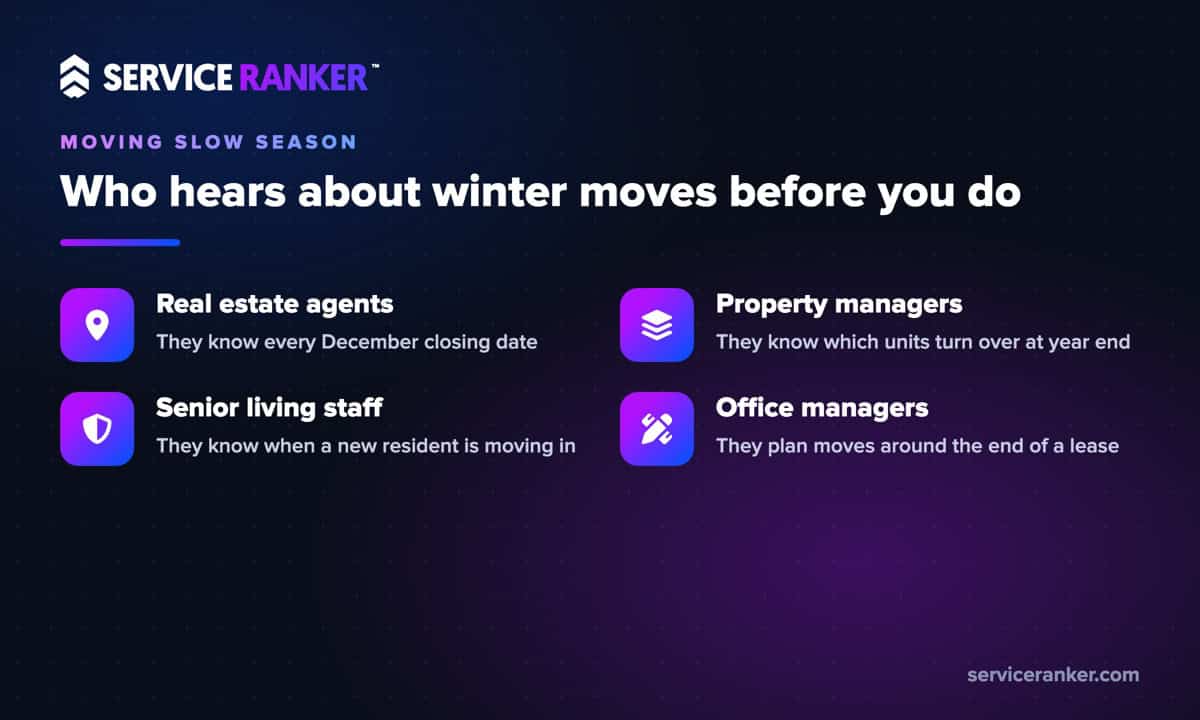
Slow weeks are the right time to reach them, because you have the time and they remember who showed up. Drop off a short sheet with your availability and the moving services you offer, ask how they like to refer, and follow through fast on the first job they send. One good agent or property manager can send moves through every slow season after that.
Office managers belong on that list too. Businesses relocate year round when their leases end, which is why winning commercial moving contracts is one of the steadiest ways to keep crews working in winter.
Use the quiet weeks to set up peak moving season
The slow season is also the cheapest time to build for the busy one. Peak season gets won before it starts, and the work that wins it is easier to do when the crew isn’t running three jobs a day.
Use December and January to ask fall customers for reviews, add real job photos to your profile, and fix the pages that didn’t pull their weight this year. A review asked for in December is still working in June. The movers who fill the summer calendar early are usually the ones who used the winter to get visible.
Fewer moves doesn’t have to mean an empty schedule. Stay findable for urgent winter searches, answer every call, and keep in touch with the people who send moves your way. If you’d rather spend the slow months running crews than running marketing, we can help keep your phones busy through the slow months. You run the moves, we keep the calls coming.