
A customer needs a company they can trust, so they open ChatGPT or Google’s AI and ask, “who’s the best one near me?” The AI gives back two or three names. Here is the part worth sitting with: it made that call before Google showed a single blue link, and the customer may never scroll past it. If the AI does not name you, you are out of the running before the search even really started.
So how does it decide? It is not random, and it is not a black box you cannot touch. AI recommends the businesses it understands best and trusts most, and almost every signal it uses is one you can shape. Most owners have simply never been shown which signals those are, or that they were even in the running.
How AI decides which business to recommend
An AI answer is built on top of everything the internet already knows about you, filtered for what the AI can read clearly and verify. When someone asks for a recommendation, it is weighing a few things at once: what your own website says you do, what your Google Business Profile confirms, what other sites say about you, and what your customers say in reviews. It then names the businesses it is most confident about, because a confident, safe answer is the whole point of an AI recommendation.
That is the key shift. AI is not hunting for a hidden gem. It is looking for the clearest, most consistent, best-supported answer it can give. Be that answer and you get named. Be vague or inconsistent and it quietly moves on to someone else.
Where AI gets its information about you
AI does not know your business personally. It assembles a picture from a handful of sources, and each one either strengthens or weakens the case for recommending you.
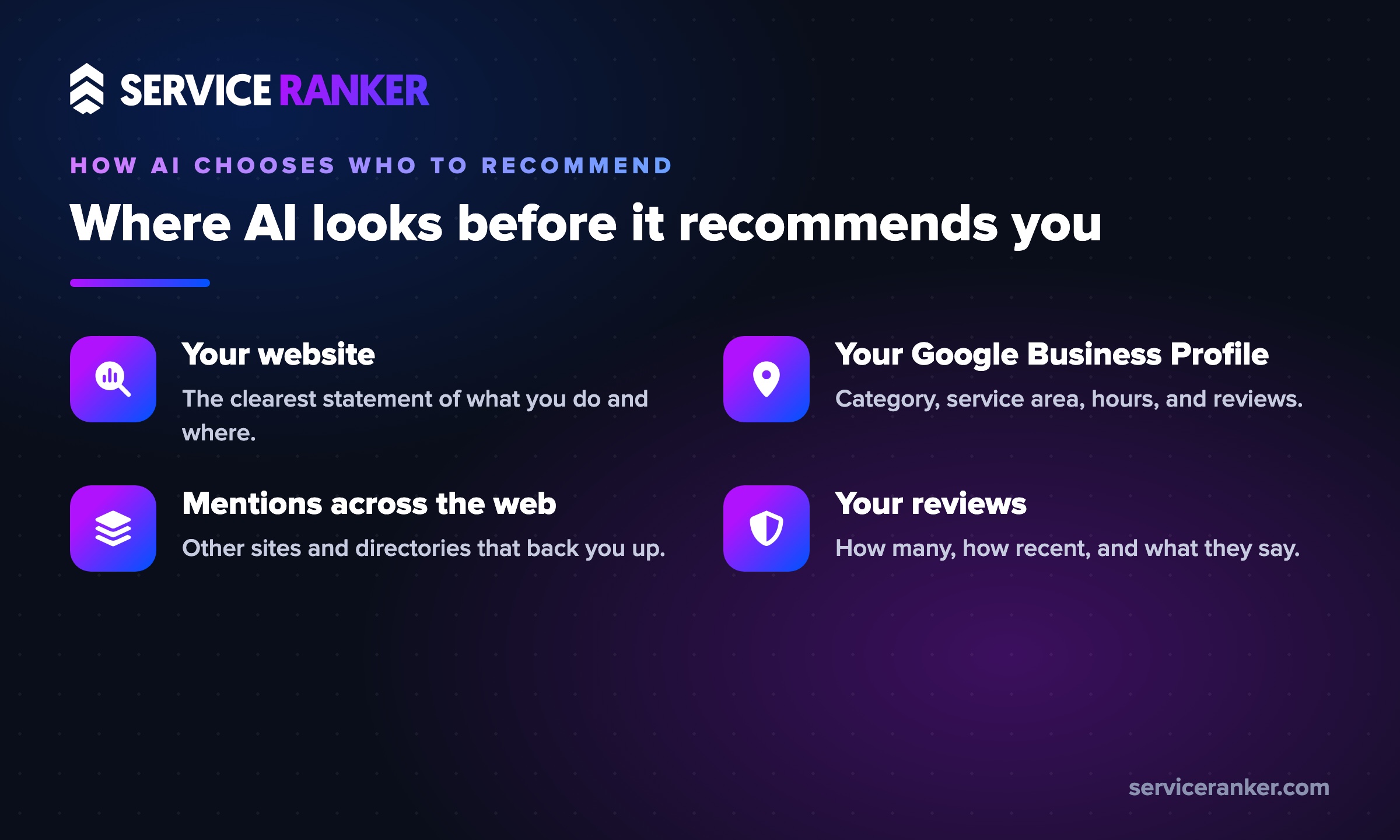
- Your website. The clearest statement of what you do, for whom, and where. If it is vague, the AI has little to work with.
- Your Google Business Profile. Category, service area, hours, and reviews, straight from the source Google trusts most.
- Mentions across the web. Other sites, directories, and articles that reference your business back up what you claim.
- Your reviews. Not just the star number, but how many, how recent, and what they actually describe.
When those sources agree and are easy to read, the AI gets confident. When they conflict or barely exist, it gets cautious. Strong answer engine optimization is really just the work of making every one of those sources say the same clear thing about you.
The trust signals that tip the decision
Two businesses can offer the same service and get very different treatment from AI. The difference is trust signals. Consistency is the big one: the same name, address, phone, and description everywhere the AI looks. Mismatched details make it unsure, and unsure businesses do not get recommended.
After consistency comes proof from outside your own site. A mention in a local publication, a healthy body of recent reviews, a profile that is clearly active. And specificity beats fluff every time. According to BrightLocal’s 2025 Local Consumer Review Survey, 93 percent of consumers read reviews before choosing a local business, and the AI is reading those same reviews to decide what to tell them.
Recency matters more than most owners expect. A wall of five star reviews that stopped two years ago reads as a business that has gone quiet, while a steady trickle of recent, specific reviews reads as one that is busy and trusted right now. The same goes for your profile and your mentions. AI is answering a question in the present tense, so it leans toward the businesses that look active today, not the ones that looked great a while back.
Why a small business can win this
Here is the good news for owners without a national ad budget. AI does not reward the biggest spender, it rewards the business it understands best. A focused local company with a complete profile, steady recent reviews, and a clear website often reads as a more confident answer than a giant brand with a vague national page. It is the same reason a three-truck plumbing shop can get named by AI over a national franchise.
That is the opposite of paid ads, where the deepest pockets usually win. In AI answers, clarity and consistency win. Say plainly who you are, what you do, and where you work, keep it identical everywhere, and you can be the name a customer hears even when a franchise is spending ten times what you are.
Picture two companies in the same town with the same four star rating. One has a complete profile, reviews from the last few weeks, a website that plainly lists its services and service area, and the same details everywhere online. The other has a thin profile, reviews from last year, and a vague site. To a customer scrolling fast they might look similar. To an AI, the first one is a clear, safe answer and the second is a question mark. So the first one gets named again and again, and the second one wonders why the phone is quiet.
What makes you easy (or impossible) for AI to recommend
The businesses AI skips usually are not bad businesses. They are just hard to read. A website that is one big photo slider with three vague lines gives the AI almost nothing. If it cannot understand you, it cannot recommend you. Clear pages that plainly state your services, your service area, and the problems you solve give it everything it needs.
You do not need anything fancy or technical. You need plain answers a real customer would search for, written in plain language. The same clarity that helps a person choose you is exactly what lets an AI quote you with confidence.
Readable does not mean stripped down or basic. It means a person, or an AI reading on their behalf, can find the answer fast. Name your services in plain words. Say the towns you cover. Answer the questions customers actually ask, like how quickly you respond and what a first visit looks like. That is the content that earns a customer’s trust and an AI’s recommendation at the same time.
How to become the business AI names
None of this is a big technical project. It is mostly cleaning up and lining up what is already out there. Start here:
- Complete your Google Business Profile with the right category, full services, real service area, and current hours.
- Keep recent reviews coming in and reply to them. Recent and specific beats old and generic.
- Make your business details identical everywhere so nothing the AI finds contradicts anything else.
- Write plain pages that answer the real questions your customers ask.
AI recommendations are still early, showing up in only about 7 percent of local searches today, so search and the map pack still bring most of your work. But that share is climbing fast, and the businesses that get clear and consistent now are the ones AI will name later. If you would rather run your business than sort all this out, that is exactly what we handle. See how we help owners get found in AI search. You run the jobs, we keep the calls coming.