
You can have the best crew in town, fair prices, and a wall of happy customers, and still be invisible to the tools more and more people use to find a company. When someone asks ChatGPT or Google’s AI who to call, it answers from what it can read about you online. If AI cannot read your website, it cannot recommend you, no matter how good you are at the actual work.
The good news is that getting named by AI is less about clever tricks and more about a website it can actually understand. Most home service sites were built to look nice, not to be read by a machine. Fixing that is straightforward once you know what AI is looking for.
Why AI can only recommend what it can read
An AI answer is stitched together from pages it can pull apart and understand. When your site is one big photo slider with a few vague lines, there is nothing for it to grab. When your pages plainly state what you do, the problems you solve, and where you work, you hand it exactly what it needs to name you with confidence. AI is not judging how pretty your site is. It is judging how clearly it can be read.
This is why a plain, well-organized site often beats a slick one full of stock photos and marketing fluff. The slick site looks great to a person for two seconds. The clear site actually answers the question, which is what both a customer and an AI are really after. Clarity beats polish here every single time.
Deep pages beat a thin homepage
Here is the fact that surprises most owners. Your homepage is not the page that gets you found by AI. In a Search Engine Land analysis of roughly 8,000 AI citations, 82.5 percent of the pages AI cited were deep, specific pages, not homepages. AI wants the page that answers the exact question, and your homepage tries to answer all of them at once.
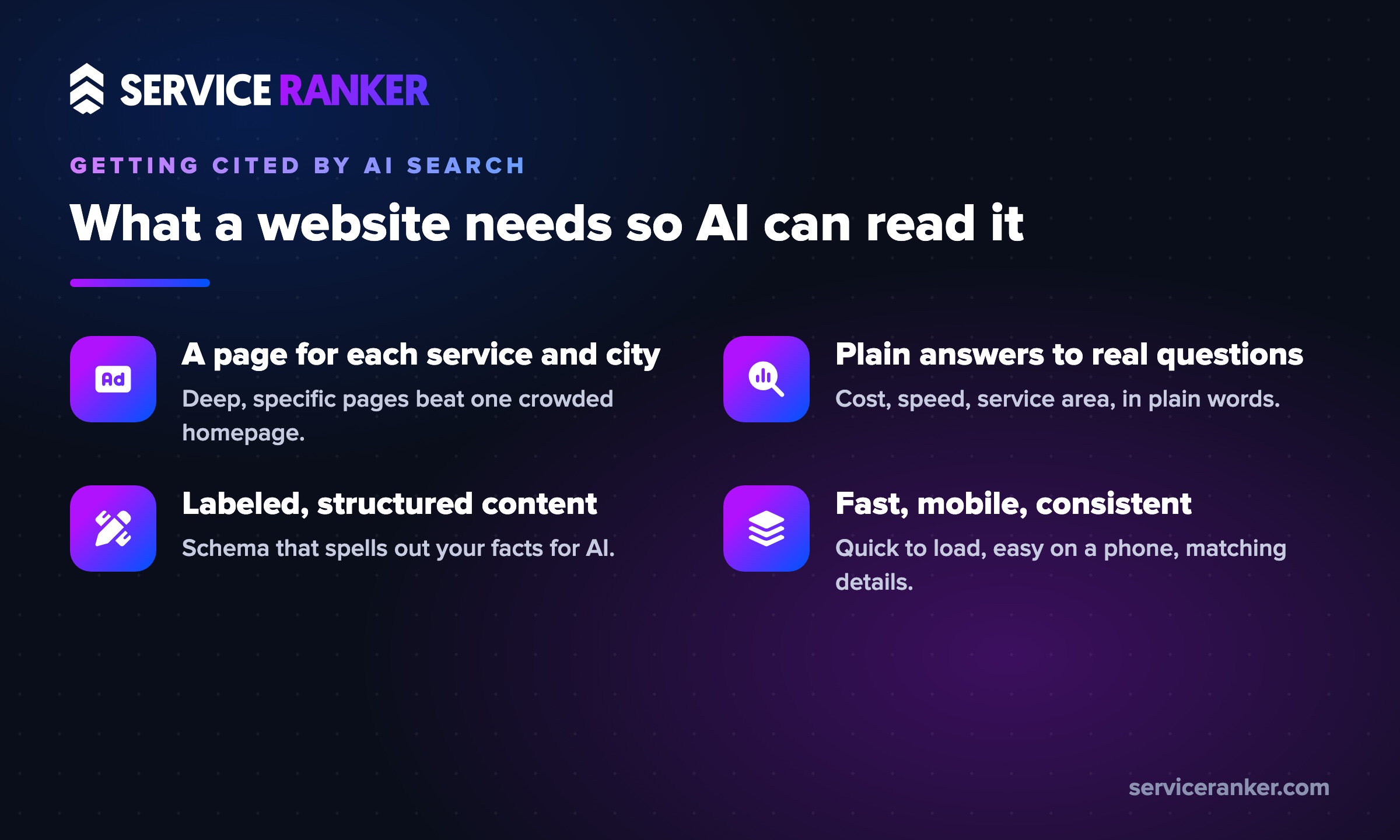
For a home service business, that means a real page for each service and each city you cover. A page about drain cleaning in one town can get you named for that exact search. A homepage that lists ten services in one paragraph cannot. This is the backbone of good home services web design, and it is the single biggest thing most owners are missing.
Think about what the AI actually sees. A dedicated page titled for drain cleaning in your town, with a plain description of the problem, your process, and your service area, is a clean answer it can quote. The same information buried three sentences into a homepage that also covers water heaters, repiping, and remodels is noise it has to untangle, so it moves on. That same study found Google’s AI answers pull from blog and article pages nearly half the time, one more reason a site with real, specific pages gets named while a one-page brochure does not.
Write pages the way people actually ask
Once you have a page for each thing you do, the words on it matter. Write the way a customer would ask, not the way a brochure would read. Plain language wins. Use clear headings that match real questions, answer them directly, and skip the jargon. If a homeowner would not say it, do not put it on the page.
Cover the things people actually want to know: what a job costs, how fast you show up, whether you handle emergencies, and the towns you serve. When your page answers the real question in plain words, AI can lift that answer and hand it to the person asking. Vague, keyword-stuffed pages get skipped because there is no clean answer to pull.
A quick test: read your service page out loud. If it sounds like a person explaining the job to a neighbor, you are close. If it sounds like a company describing itself in the third person, rewrite it. AI, like a customer, is looking for the answer, not the sales pitch.
The labels that tell AI what your page is
There is a behind-the-scenes piece too, and it is simpler than it sounds. Structured data, sometimes called schema, is just a set of labels on your page that spell out the facts for a machine: this is the business name, these are the services, this is the service area, these are the reviews. It removes the guesswork. Instead of hoping AI figures out your details from the text, you hand them over clearly.
You do not need to code this yourself, and you should not have to think about it much. A site built the right way includes these labels from the start. The point to understand as an owner is that the label work matters, because it turns a page AI has to interpret into a page AI can simply read off.
Here is what that looks like in practice. Without labels, AI reads your page and guesses which words are your business name, which are services, and which are just marketing. With labels, it is told outright, so there is no room to get it wrong. On a home service site that means your services, your service area, and your reviews all get handed over cleanly, which is exactly the information an AI needs to recommend you.
The basics that quietly decide it
A few plain fundamentals do more than any trick. Your site has to be fast and work on a phone, because that is where these searches happen and a slow page loses both people and machines. Your name, address, and phone should match everywhere, so nothing AI finds contradicts anything else. And every image should have real alt text describing it, since that is one more thing AI reads.
None of this is flashy, which is exactly why so many sites skip it. But these basics are what separate a site AI trusts from one it quietly passes over. Get them right and everything else you do works better. A fast, clear site is the quiet foundation the flashy features are supposed to sit on, and skipping it is why plenty of good looking sites still never get named by AI.
What to fix on your site first
You do not have to rebuild everything at once. A few focused fixes move the needle fastest. Start here:
- Build a real page for each service and each city you cover, each answering one clear question.
- Rewrite your key pages in plain language, answering what customers actually ask about cost, speed, and coverage.
- Make sure your business details match across your site, your Google profile, and every listing.
- Get the basics solid: fast load, mobile-friendly, real alt text, and structured labels on your pages.
AI search is still early, and most of your competitors have not thought about any of this yet. That is the opportunity. The businesses that get their site clear and readable now are the ones AI will name as more of your customers start asking it who to call. If you would rather run the jobs than sort out schema and site structure, that is what we do. We build a site AI can read, on a framework made for it. You run the jobs, we keep the calls coming.