
Most moves stay close to home, but not all of them. The Census Bureau found that 11.8 percent of people moved in 2024, and 2.1 percent moved to a different state. Put those two numbers together and roughly one mover in six crossed a state line. For moving companies that run long-distance jobs, that slice is often where the best money lives.
Here is the catch. On a long-distance job, the customer is usually not in your city when they start looking. They are packing up in the other one. Most moving company SEO is built for the town where the trucks park, which covers one end of the trip and quietly ignores the other. If half your jobs start somewhere else, half your marketing has to show up somewhere else too. Moving companies get more customers from Google by winning both ends: a complete profile for the home city and real route pages on the website for the family in the other one.
Long-distance moving companies serve two cities but rank in one
Every long-distance job has an origin and a destination. When you are based at the origin, the shopper is local. They search “movers near me” from their couch, Google sees they are close to you, and your profile has a fair shot. That is the end most movers are already set up to win.
The other end works differently. Say your company is in Austin and a family in Denver is relocating there for a new job. They are searching from Denver, typing things like “Denver to Austin movers” or “moving company Austin.” Their phone is hundreds of miles from your yard. That customer is real, ready to hire and nowhere near you.
Inbound moves like this are some of the best jobs a mover can get. The family has a hard date, a whole household and often a relocation budget. But they will only call the companies that show up from where they are sitting, and the tools most movers rely on were never built to reach them.
Why your Google Business Profile only covers your end
Google is clear about this. Its service area guidelines say the boundaries of your service area shouldn’t be more than about 2 hours of driving time from where your business is based, and you can list up to 20 areas. A mover in Austin cannot list Denver, Phoenix and Atlanta just because the trucks go there. The profile is a local tool by design.
Google also says local results are ranked mainly on relevance, distance and prominence. Distance works in your favor at home and against you everywhere else. The map pack will never carry you to the far end of a move. That job falls to your website, because search engines can rank a web page for a search typed anywhere in the country.
None of this makes the profile less important. It still wins the local half of your business, and we covered the photos, reviews and service area basics in how movers fill the summer calendar before their competitors. The point here is simpler. For the family in the other city, your website is the only part of your company that can show up.
Paid search can bridge the gap while pages build. Google Ads lets you target people by where they are searching from, so a mover in Austin can show ads to Denver searchers looking for Austin movers. It costs money per click, so treat it as a bridge for your best routes, not the whole plan. The organic SEO pages are what keep working after the ad budget stops.
Route pages on your website that earn their place
The obvious move is a page for every route, and this is where a lot of movers get burned. Google’s spam policies list “pages targeted at specific regions or cities that funnel users to one page” as doorway abuse. Fifty pages that swap one city name for another are exactly that. In our own work we have watched Google simply decline to index thin, templated city pages. A page Google will not index cannot rank or ring the phone.
A lane page earns its place when it says something only that lane needs. Four things do most of the work: the route you actually run and how often, what the customer will find at the destination, honest timing and how the move works over that distance, and proof from customers who made that exact trip. A page with those four is useful content for a family in Denver. A page without them is a template with a new city name.
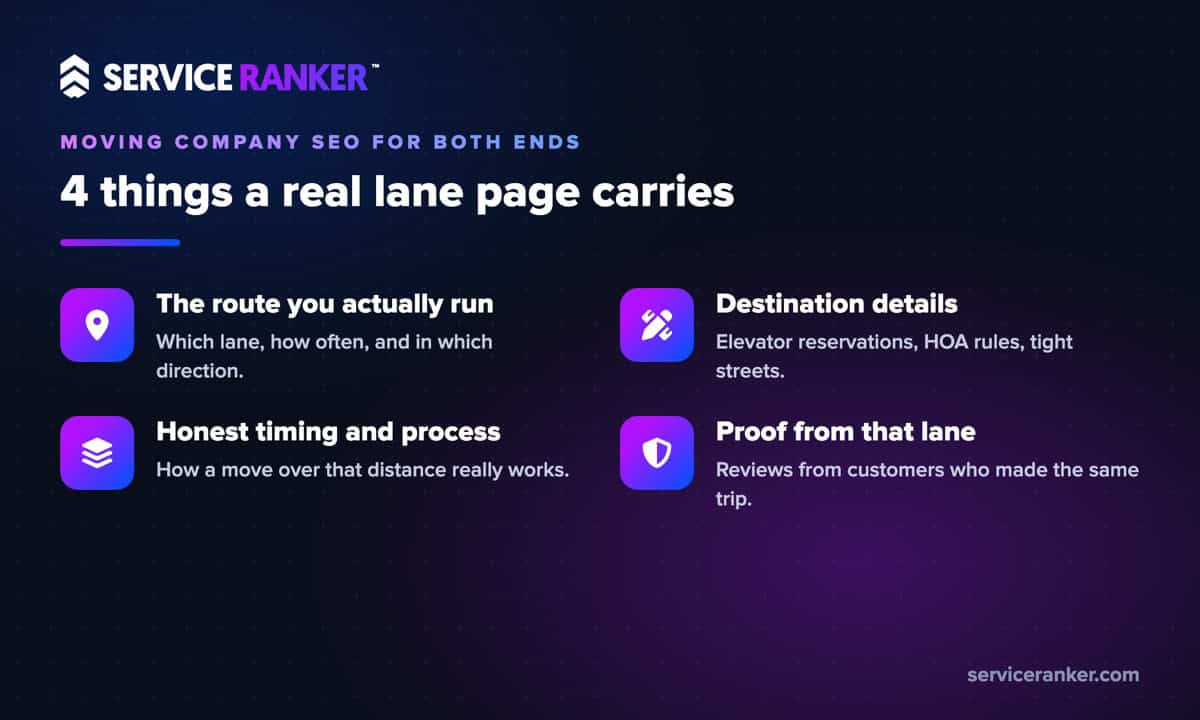
The destination details are where you stand apart. You know the apartment complexes that require elevator reservations, the HOAs with move-in rules and the neighborhoods where a full-size truck cannot turn around. That local knowledge is the content nobody else can copy. It is also the reason our marketing for long-distance movers starts from the lanes you already run, not from a list of every state on the map.
What a customer in another city checks before calling
A local customer can drive past your yard and see the trucks. The family in Denver cannot. They are trusting a company in a city they may never have visited with everything they own, so they check harder. The U.S. Department of Transportation’s Inspector General tells consumers to confirm a mover’s FMCSA registration and look up its address on street view to make sure it is a real business and not a residence.
Your website should answer those checks before anyone has to run them. Put your USDOT number where a nervous customer will see it, not buried in the footer. Show your real address, photos of your own trucks and crew, and a plain explanation of how long-distance estimates work. If you are the carrier and not a broker, say so in plain words.
Reviews matter most when they match the trip. A review that says “moved us from Denver to Austin and showed up on the day they promised” does more for an out-of-state shopper than a dozen reviews about local apartment moves. Ask your long-distance customers to mention where they moved from. Route-specific reviews answer the exact fear of the next customer on that route.
Choosing which routes your SEO should cover first
Do not start with a map of the country. Start with your own job history. Pull the last year of long-distance jobs and list each one by origin and destination. Often a handful of lanes carry most of the volume, such as a few nearby metros and one or two retirement or job-growth destinations.
Build those lanes first and build them well. Searches for a specific city pair are small next to “movers near me,” but the person typing one has already decided where they are going. A few deep lane pages beat fifty thin ones every time. Once a page is pulling quote requests and leads, add the next lane from the list.
Watch direction too. Some lanes run mostly one way, and if your trucks come back empty, the return trip is a lane worth marketing on its own. A page aimed at people on that return route can turn deadhead miles into paid jobs, which is a better use of the truck than any discount.
Tracking moving leads from both ends
You cannot grow a lane you cannot see. Add two fields to your quote form: where the person is moving from and where they are moving to. Ask the same two questions on every phone call and put the answers on the ticket. Within a season, you will know which lanes your website is actually winning.
Then look at the searches. Google Search Console, which is free, shows the queries people typed before they landed on your site. Watch for city names that are not your own. When the other city starts showing up in your search data, the lane page is working. Your Google Business Profile reports calls too, but remember it only measures the home end of the move.
Check one number each month: the share of long-distance quote requests that started in another city. If it climbs while your local jobs hold steady, you have opened a second market without opening a second location. Social media and paid lead generation services can fill gaps. The customers you win through your own search results are yours to keep.
A long-distance move has two ends, and the customer can start at either one. Your profile wins the end you live in. Your website has to win the other. If you want a partner who builds that for the lanes you already run, we can help your moving company win both ends of the move. You run the moves, we keep the calls coming.