
Ask most dumpster rental business owners where they want to rank and you’ll get a long list. Every town within an hour, plus the big city everyone drives past. It sounds ambitious. In practice, it spreads your website and Google profile thin and fills the calendar with rentals that barely pay for the diesel.
Here’s a better way to decide. Dumpster rental SEO should target the towns your trucks reach profitably, in that order. Start with the towns closest to your yard and your dump site, then work outward only as far as the numbers hold up. That order tells you which service areas go on your Google Business Profile, which town pages to build first and which towns to leave alone. To rank in more towns, add them in tiers: win the map pack near your yard with your profile and reviews, then reach farther towns with town pages worth reading. Your delivery map is your keyword list.
Why delivery distance decides dumpster rental SEO
Every dumpster rental is at least two round trips. The truck drops the container, then comes back to pick it up and haul it to the landfill or transfer station. Distance hits a dumpster rental company on every leg, which is why a far-off town costs more than it looks.
Do the math on a town 10 miles farther out. That’s 10 more miles out and 10 back on the drop, then the same on the pickup. Ten extra miles each way adds about 40 truck miles to every rental, before you count the longer run to dump the load.
Those miles aren’t cheap. The American Transportation Research Institute’s 2026 report found the industry-average cost to operate a truck in 2025 was $2.336 per mile, the highest in the report’s history. That figure comes from for-hire trucking fleets, and a roll-off truck running short local routes won’t match it exactly. Still, by that yardstick, 40 extra miles is roughly $93 on each of your dumpster rentals. Run your own numbers, but the point holds. A town that adds miles to every job has to earn its place on your list.
Most of the dumpster rental SEO advice you’ll find online skips this part. It treats every town as equal, so owners chase local SEO rankings in places where winning the call means losing money on the job.
Map the towns your trucks reach profitably
Before you touch your website, build the map. It takes an afternoon with last year’s orders and a spreadsheet.
- Pull last year’s rentals by town. Count orders, container sizes and how long each one stayed out.
- Add drive time from your yard. Use real drive times at the hours your trucks run, not straight-line miles.
- Add the dump run. Note how far each town is from the landfill or transfer station you use. A town next to the dump can beat a closer town on the other side of yours.
- Mark the stretch towns. These are the places that pay only with a longer rental, a bigger container or a delivery charge.
- Sort the list. Group every town as core, stretch or no-go.
Core towns are where you want every call you can get. Stretch towns are worth showing up in, but only on terms that cover the drive. No-go towns stay off your website and profile entirely, even if a competitor is chasing them.
Don’t be surprised if your core list is shorter than you expected. The stretch list is usually where margin leaks out without anyone noticing.
Google ranks you by distance too
Here’s the good news. The towns that make you the most money tend to be the easiest ones to rank in. Google says local results are mainly based on relevance, distance and how well known a business is, and that distance refers to how far each business is from the customer who’s searching.
When someone types dumpster rental near me, Google is weighing where they’re standing. That means the map pack naturally favors you in the towns around your yard, which are the same towns your trucks serve cheaply. Your margin and Google’s distance factor point in the same direction. Farther out, the map pack gets harder to win, because a homeowner searching there is closer to someone else.
So split your local SEO work by tier. Core towns are map pack territory, won with your Google Business Profile, reviews and photos of real drops. Stretch towns are mostly won with town pages on your website, which can rank in regular search results beyond the map. No-go towns get neither. That tiered order is how we approach marketing for dumpster rental companies: profile and core towns first, stretch towns as reviews and orders come in.
Set your Google Business Profile service areas to match
Your profile’s service areas should mirror the map, not your wish list. Google lets you set up to 20 service areas by city, ZIP code or other area, and it no longer accepts a radius around your yard.
Google’s guidelines also say the boundaries of your overall service area shouldn’t extend farther than about 2 hours of driving time from where your business is based. For most dumpster rental companies, the profitable line sits well inside that limit.
List your core towns first, then your best stretch towns, and stop there. Twenty slots is plenty when you’re only listing places you actually want to drive. Service areas tell homeowners where you deliver. Ranking in each town still depends on distance, your reviews and your website.
Build website pages in the order your trucks profit
Town pages are how a dumpster rental company reaches the stretch towns the map pack won’t hand it. Build them in tier order, core towns first, and only as fast as you can make each one genuinely useful. A page that swaps the city name into the same paragraph doesn’t help a homeowner, and Google’s spam policies list substantially similar pages targeted at specific cities as doorway abuse.
What makes a dumpster town page real is detail that changes from town to town. Street placement rules are a good example. In Minneapolis, a street use permit is required to put a dumpster in the street, and only a licensed contractor can apply. A homeowner planning a driveway-versus-street drop wants to know that before they order.
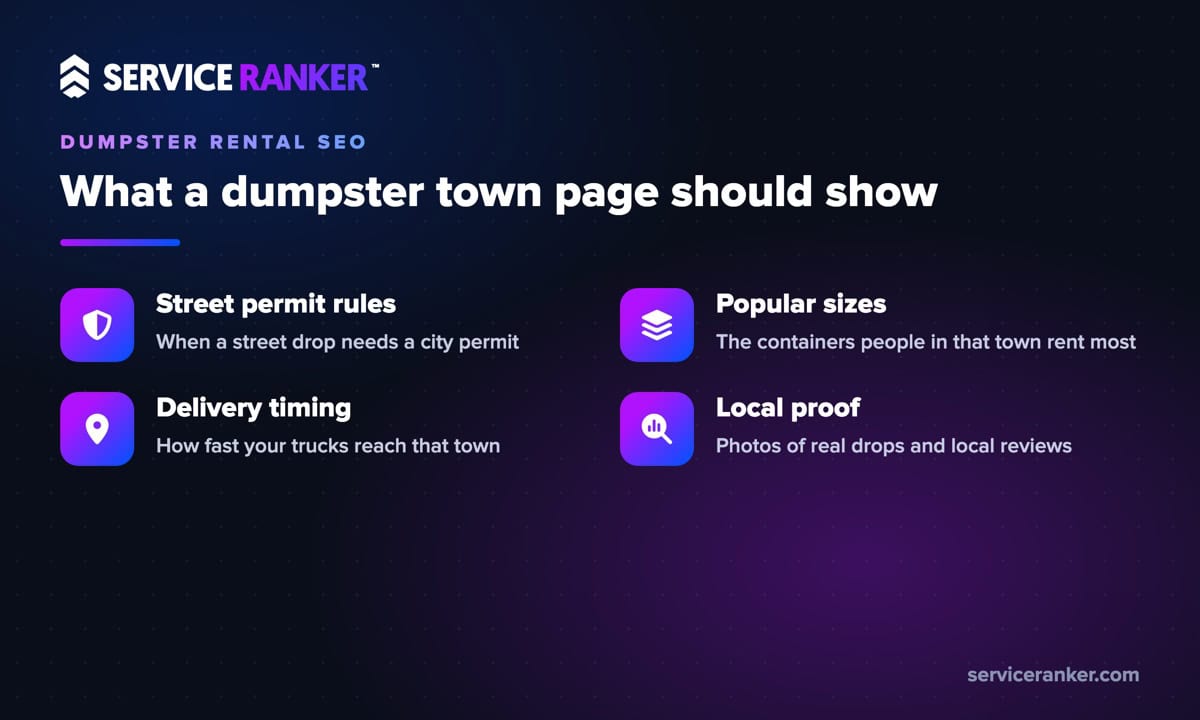
Beyond permits, a strong town page shows the container sizes people there rent most, how fast you can deliver, the services you offer there, and proof you work there. That means photos of real drops and reviews from local customers, which build more trust than any claim you can write. One honest page for a core town beats ten copy-paste pages for towns you’d rather not drive to.
Size and project pages come next. A page for a 20 yard dumpster for garage cleanouts or a 30 yard dumpster rental for remodels answers what people search once they know the job. Link those pages from your core town pages, so the content works together instead of competing.
Re-rank the list with real orders
The map isn’t a one-time project. Track every dumpster rental call and form by town, then check it against what each rental actually made after the drive and the dump run. The towns that bring the most calls aren’t always the ones that bring the most profit.
It’s common for a busy stretch town to look like a win on call volume alone. Count the drive and the dump runs, and a quieter core town can turn out to be the better place to push for reviews and rankings. When that happens, move the effort, not just the spreadsheet.
Review the list each spring and fall. Move towns up when they prove profitable, down when they don’t. And if a town keeps showing up only through lead sellers, that’s a sign the demand is real and you should be the one catching it, not paying brokers for dumpster rental leads.
Rank where your trucks make money, in that order, and let the list grow as the orders prove it out. If you’d rather keep the trucks moving than build town pages, we can help you rank in the towns your trucks reach. You run the routes, we keep the calls coming.