
Ask most roofing contractors what their website ranks for and you’ll hear “roof repair.” But repair is not where a roofing company makes its year. Roofing SEO pays off on the replacement page and the handful of pages that lead into it: insurance claims, storm damage, inspections and the roof types you install. So how do roofing companies rank higher on Google? They build a real page for each job worth winning, prove local work on every one of them, and back those pages with a complete Google Business Profile and steady reviews. That is search engine optimization for roofers, page by page.
Repair wins the search volume, replacement wins the money
Repair searches outnumber replacement searches a little more than two to one, but a repair click costs about the same. That comes from Google Ads keyword data we pulled for the U.S. in October 2026. “Roof repair” and “roof repair near me” draw about 164,500 searches a month combined. “Roof replacement” and “roof replacement near me” draw about 73,600. Here is the split, with the average cost per click for each search:
| Search | Monthly U.S. searches | Avg cost per click |
|---|---|---|
| roof repair near me | 90,500 | $39 |
| roof repair | 74,000 | $41 |
| roof replacement near me | 40,500 | $30 |
| roof replacement | 33,100 | $31 |
| roof inspection | 33,100 | $35 |
| metal roof installation | 18,100 | $23 |
| storm damage roof repair | 3,600 | $47 |
Advertisers pay $41 for a repair click and $31 for a replacement click, and the job behind the replacement click is a full tear-off. The same math applies to organic search results. A ranking is worth what the job behind it is worth, not how many people search the phrase. Plenty of roofing SEO strategies chase the biggest number, and the roofing business that ranks first for repair and nowhere for replacement gets a busy phone and a thin month.
The four website pages that carry roofing SEO
Four pages carry most of the value in roofing SEO: roof replacement, insurance and hail claims, storm damage and roof inspection. Most roofing websites have one “services” page that lists everything in a paragraph, so Google has nothing specific to rank and a homeowner has nothing specific to trust. A stronger roofing website gives each money job its own page.
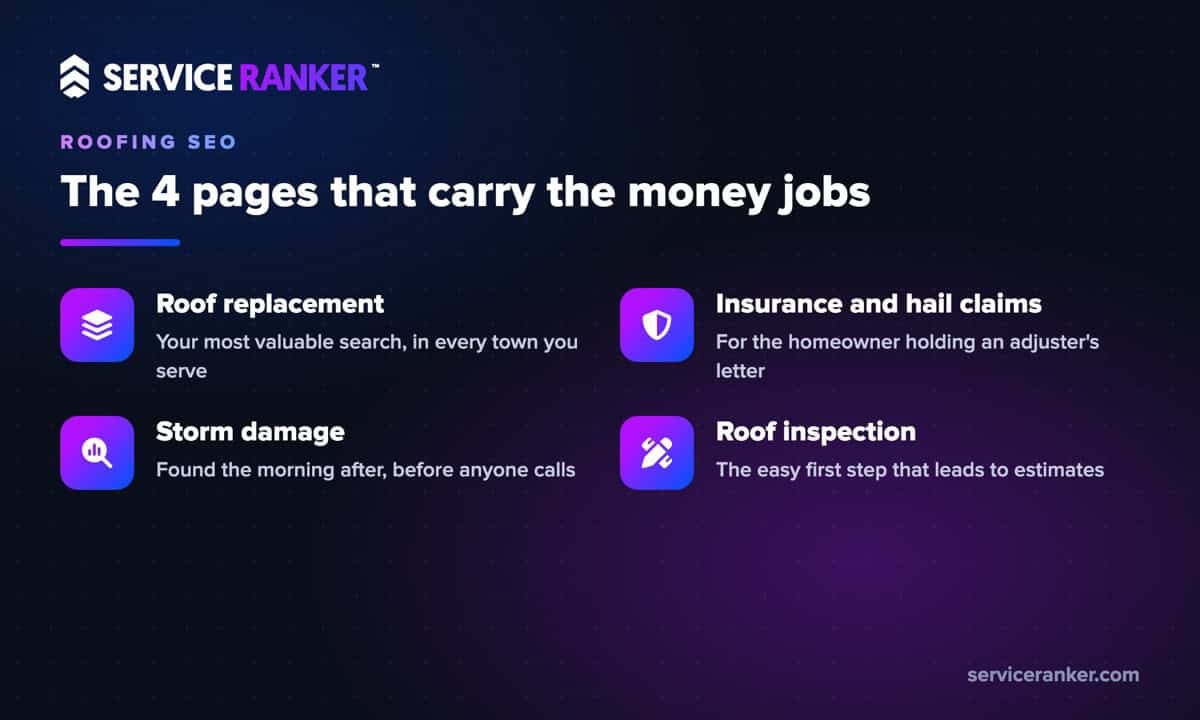
The roof replacement page should rank for your most valuable search in every town you serve. The insurance and hail claim page is for the homeowner holding an adjuster’s letter and wondering what happens next. The storm damage page catches the morning after a storm, when people search before they call anyone. And the roof inspection page is the low-pressure first step that turns into replacement estimates.
Behind those four sit the roof types and services you actually sell. Metal roof installation alone draws about 18,100 U.S. searches a month in the same data, so if you install metal, it deserves its own page. Repair still gets a page. It just stops being the page your roofing SEO strategy is built around.
Replacement page content that ranks and gets the call
A replacement page ranks and gets calls when its content answers the questions a homeowner has before spending five figures, with proof that you do this work locally. Write it for the person deciding, not for a keyword tool. They want to know:
- How the replacement works, from inspection to cleanup, and how long it takes.
- Which materials you install and why you would recommend one over another.
- How you handle insurance, permits and warranties, and financing if you actually offer it.
- What your finished roofs look like, in your towns, with real photos.
The on-page SEO basics still matter. Put “roof replacement” and your main town in the title and first heading, and give the page one clear next step, usually a free inspection request and a tappable phone number. Technical SEO is just as plain: the page loads fast on a phone, Google can crawl and index it, and it links to your storm, insurance and inspection pages. What most roofing company websites skip is local proof on the page itself: a recent job in a named neighborhood, the shingle line you used, a short review from that homeowner. That kind of content marketing is what separates your roofing page from the forty template pages Google has already seen.
Storm and insurance pages built before the hail
Storm damage drives a big share of the replacement work in roofing. Wind and hail accounted for 42.5% of homeowners insurance losses in 2023, the largest single cause, and the average wind and hail claim from 2019 to 2023 was $14,747, according to Insurance Information Institute data from ISO. A claim that size is a roof, not a patch.
A page published the week of the storm has not had time to rank, so it misses the rush, and lead generation companies selling the same storm leads to several roofers get there first. Storm and insurance pages need to be live and indexed months before storm season. Explain what hail damage looks like, how an inspection works, what to expect from the adjuster, and how you document damage. Keep it honest. Pages that promise a free roof read like the crews homeowners have learned to distrust, which is the whole fight in how local roofers beat the out-of-town storm chasers. Plain, accurate content earns the call and the referral after it.
Local SEO and your Google Business Profile decide the first call
Your website pages win organic search results, but many homeowners call straight from the map pack. Google says local results are ranked on relevance, distance and prominence, and that complete business information plus more reviews and positive ratings can help a business rank. Review count is not the whole story, as we covered in why the company with worse reviews can still win the map pack. That is why local SEO for roofing contractors is never just the website.
Point your Google Business Profile optimization at the same money jobs. List roof replacement, storm damage and insurance claims as services with real descriptions, link the profile to the right page on your website, and post photos of finished replacements, not just crews on ladders. Ask happy replacement customers for online reviews that mention the job and the town, because those words help with relevance in a way a bare five stars can’t. That is the core of our search marketing for roofing companies, built around the jobs you want more of.
Town pages for roofing companies without the copy-paste
Every roofing contractor serving several towns wants a page for each. Done right, it helps local SEO. Done the easy way, it hurts. Google’s spam policies name pages targeted at specific regions or cities that funnel users to one page as doorway abuse. Twenty copies of the same text with the city name swapped is exactly that, however clean the on-page SEO and technical SEO look, and it’s one of the most common shortcuts we see in SEO for roofing.
Build a town page only when you have something true to say about that town. Name the neighborhoods you’ve roofed, the storms that came through, the roof styles common on older homes there, and show local jobs you finished nearby. Start with the two or three towns where you already do the most replacements. A few real town pages beat a pile of thin ones, and they convert better because homeowners can see you’ve worked on their street.
A roofing SEO strategy where repair still earns its keep
None of this means you drop repair. Repair is the front door. A homeowner who calls about a leak is often living under a roof near the end of its life, and an honest inspection on that visit is where many replacement leads start. Treat the repair page as a feeder: answer the repair question, then offer a full inspection and link to the replacement page. Homeowners tend to be glad they replaced. New roofing was one of only three projects to earn a perfect Joy Score of 10 in the NAR 2025 Remodeling Impact Report, and REALTORS named it among the top projects they recommend before a sale.
Of all the digital marketing a roofing company pays for, SEO is the easiest to judge by traffic and the hardest to judge by money, so most roofing contractors stop at traffic. Track calls, leads and inspection requests by landing page instead, whether they come from Google Ads or organic search. If your repair page brings in most of the leads and almost none turn into estimates, that is your answer. Judge SEO results by estimates, not visits. Build the pages that produce replacement estimates, and let your team close them at the kitchen table. If you’d rather have someone build and rank those website pages, here is how we help roofing contractors get found for bigger jobs. You run the jobs, we keep the calls coming.