
The first frost shows up in the call log before it shows up in the forecast. Mosquito calls stop. Ant calls slow to a trickle. A lot of pest control business owners look at the ad bill that month, see fewer calls behind it, and shut the whole account off until spring.
Should a pest control company keep running Google Ads in winter? In most cases, yes, just not the same ads and not the same budget split. Winter changes what people search for, not whether they search. Google Ads for pest control in winter works when the budget moves to the work that keeps calling: rodents, indoor pests, year-round plans and early termite inspections. Hours and service areas get tighter, too. Here is how we shift pest control Google Ads accounts when the season turns, and what to switch back on before spring.
Winter changes what pest control customers search for
Cold weather moves pest control searches from outdoor pests to indoor ones. Connecticut’s state mosquito program notes that mosquitoes do not generally feed in temperatures below 50 degrees F, and many adults hibernate before the first frost. Once nights stay under that line, mosquito searches fall off, and so do the calls.
Other pests move the opposite way. University of California pest experts say house mice frequently enter homes in autumn when nighttime temperatures become colder. Roaches and bed bugs live indoors and do not care what the thermometer says. A homeowner who finds droppings in the pantry in December searches just as fast as one who found a wasp nest in June.
The Google search numbers we pull for pest control keywords show the same split every year. Mosquito searches drop hard by November. Rodent searches hold steady through the winter months, and termite inspection searches stay well above zero before climbing again in spring. The demand does not disappear in winter. It changes shape.
In practice, four kinds of pest control work tend to keep calling once it turns cold.
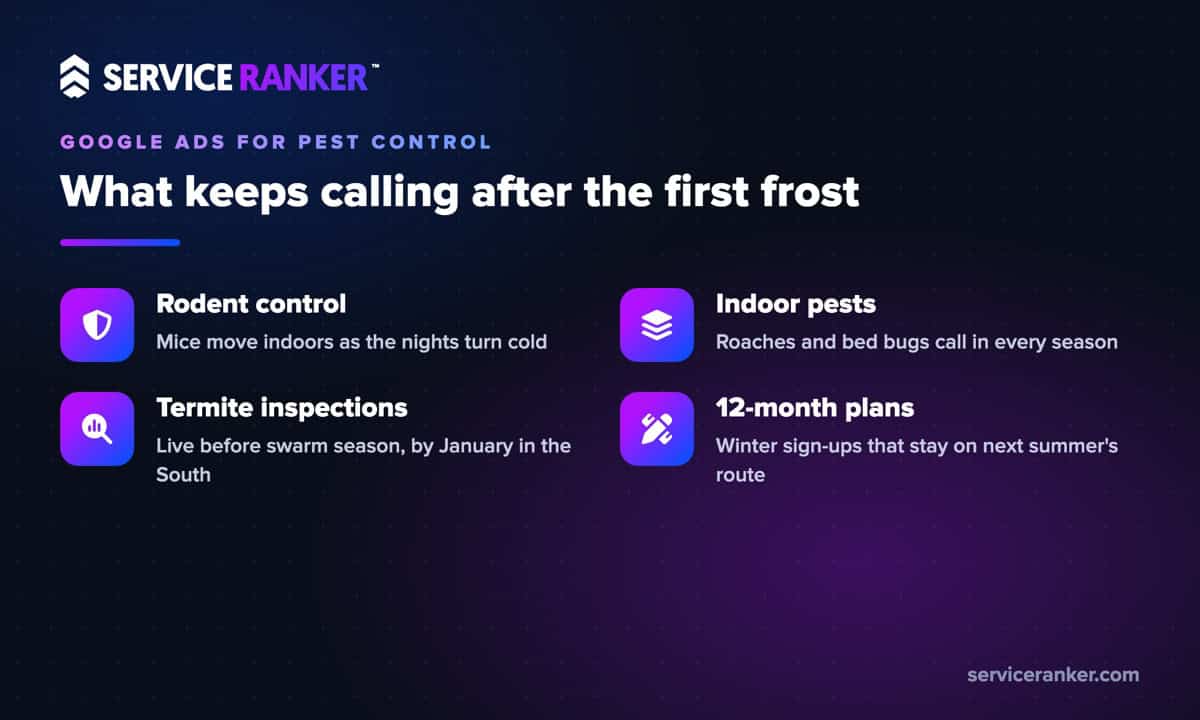
Move Google Ads budget to the pest control services that keep calling
The way to keep Google Ads working in winter is to stop treating the account as one switch. When each service line runs as its own campaign, with its own budget, you can turn mosquito ads off without touching rodent ads. When everything sits in one campaign called “pest control,” the only choices are leaving summer keywords running or shutting the whole thing off. Separate campaigns help you choose, service by service.
So the first winter job is sorting the account by the work you want. A practical setup looks like this:
- Rodent control gets its own campaign, with keywords like mouse exterminator and rodent control near me, and ads that talk about inspection, sealing entry points and follow-up visits.
- Indoor pests such as roaches and bed bugs keep running all year, because the calls do not follow the weather.
- Wildlife removal only belongs in the account if you actually do the work. Do not pay for clicks you will refer out.
- Mosquito and outdoor pest campaigns get paused, not deleted, so their keywords and history are ready in spring.
Before you move the money, clean up the keywords. Add negative keywords for searches you do not want to pay for, such as DIY mouse traps or pest control jobs, so the fewer winter clicks come from customers and not from shoppers or job seekers. Then move the money. The budget you were spending on mosquito clicks in August usually belongs on rodent and indoor pest campaigns in December. In the pest control accounts we manage, the call mix shifts toward rodents in late fall every year, and the owners who keep those campaigns funded tend to keep winter calls coming while competitors who shut off go quiet. Choosing where the winter budget goes is a big part of the Google Ads work we do for pest control companies.
Sell the 12-month plan while the yard is quiet
Winter is a good time to advertise the service that pays you all year. A homeowner who just dealt with mice is primed to hear why a recurring plan makes sense, and a winter sign-up is a route stop you keep through next summer. The best winter ad is often the one that builds next July’s route.
Give plan ads their own campaign and their own landing page. Explain what a winter service visit actually covers, such as the exterior barrier, entry points, attic and garage checks, so the customer is not wondering why they would pay for pest control in January. Searches for things like quarterly pest control never drop to zero in winter, and those searchers are shopping for an ongoing service, not a one-time spray.
Signing customers up is only half of it. Plans that start in winter need the same follow-through as any other, and we wrote about why pest control customers cancel in year two. A plan that lapses after one season means you paid to acquire that customer twice.
Get termite inspection ads live before swarm season
Termite work runs on a calendar, and winter is when you get in front of it. Mississippi State University Extension notes that eastern subterranean termites normally swarm in spring, but swarm season can begin as early as late January or February along the Gulf Coast. The same experts recommend keeping an annual termite contract with a licensed pest control company.
For pest control companies in the South, that means termite inspection ads should be running by January, not switched on after the first homeowner calls about wings on the windowsill. When swarmers show up, people search right away, and the companies already showing get those calls. Farther north, the window opens later, but the logic is the same. Set the termite campaign to start a few weeks before your local swarm season, with ads built around inspections and annual protection.
Tighten your ad hours and target areas when calls thin out
With fewer searches in winter, every wasted click on your Google search ads matters more. Two settings do most of the work. The first is your ad schedule. Google Ads lets you set the days and hours your ads can run, so run them when someone will answer the phone, not at 2 a.m. when the call rolls to voicemail.
The second is your service area. In summer, a drive to the edge of your territory can still pay for itself. In winter, with fewer calls to group together, the far ZIP codes are usually the first place to trim. Keep ads close to the neighborhoods where you already run routes.
One setting owners ask about is seasonality adjustments. Google describes them as a tool for short events of 1 to 7 days, notes they may not work as well over periods longer than 14 days, and says Smart Bidding already handles normal seasonal swings. They are not a way to manage a whole winter. Moving budget between campaigns is.
Local Services Ads for pest control companies in the slow months
Local Services Ads are worth keeping on in winter because you pay per lead, not per click, so you can judge them by cost per lead instead of traffic. When search volume is lower, that pricing model protects you from paying for a lot of clicks that never turn into a call. Pest control services are one of the categories these ads cover, so the slow season is no reason to switch them off.
Two things changed recently that every pest control business should know. First, the old Google Guaranteed badge is gone. Google replaced it with a single Google Verified badge in October 2025, so update any website or truck that still says Guaranteed. Second, Google is moving Local Services Ads into Google Ads, and we covered what that move changes for home service companies. Winter, with fewer leads coming in, is a calm time to get that account in order.
Switch the mosquito campaign back on before spring
The last part of a winter plan is the date you undo it. Pick a day on the calendar, usually a few weeks before your local mosquito and ant season starts, to switch the paused outdoor campaigns back on, refresh the ad copy and move budget back from rodents. The companies that win the first warm week are the ones whose ads were already running.
Winter does not have to be the season your ad account goes dark or your marketing stops. It can be the season that keeps rodent and indoor calls coming, signs up next year’s plan customers and lines up termite work before anyone else. If you would rather have someone set that up and watch it, talk with us about your winter pest control ads. You run the jobs, we keep the calls coming.