
Ask a homeowner in Sunfield where they live and you might hear three different answers. The mail says Buda. The neighborhood sits on the Hays and Travis county line. And when they describe it to a friend, plenty of people just say south Austin. Then a pipe bursts, and they search “plumber near me” or “plumber Buda” and start reading websites.
That is the problem a Buda TX service area website has to solve. Name the places the way the people living there say them, in the order your trucks actually go. In practice, that means one plain service area line near the top of your homepage, a service areas page grouped by direction, and the same town names on your Google profile. Service Ranker is based in Buda, and we read a lot of websites for local home service businesses. Here is what the place names on yours should say, and where they should go.
A Buda address is not the same as Buda city limits
A ZIP code is a mail route, not a town line. The U.S. Census Bureau explains that the Postal Service assigns ZIP Codes to delivery routes, and the Census builds its ZIP code maps as approximations of those routes. So a 78610 address tells you where the mail goes. It does not tell you whether the house sits inside the city of Buda.
The gap around here is bigger than most owners think. We ran the numbers from the Census Bureau’s 2020 ZIP code relationship files, which show how each ZIP area overlaps cities and counties. In that 2020 geography, Buda city limits covered less than 10% of the land in ZIP 78610, about 9 of its 97 square miles. Roughly 79% of the ZIP sat outside any city limits at all. About a quarter of it was in Travis County, a sliver reached into Caldwell County, and pieces overlapped the city limits of Kyle, Austin, Creedmoor, Mountain City, Mustang Ridge and Niederwald.
That matters for your website because a homeowner with a Buda mailing address may not think of themselves as living in Buda at all. It is also part of why the map pack changes from one side of Buda to the other. Your customers live all over those 97 square miles, and they describe them in their own words.
How homeowners around Buda name where they live when they search
People name where they live in four different ways, and your website should cover the ones your customers actually use.
- The mailing town. Buda, Kyle, Manchaca, Driftwood. It is what shows on the water bill and in the GPS.
- The nearest big city. Plenty of people on the north side of the area say south Austin, because it is the name everyone recognizes.
- The county. Hays or Travis. It comes up on tax bills and permits, and some people use it to say where they are.
- The subdivision. Sunfield, Garlic Creek, Plum Creek, Shady Hollow. Neighbors use these names in group chats and in reviews.
The lines overlap more than you would guess. The same Census files show Manchaca’s 78652 ZIP split between Travis and Hays counties, and Kyle’s 78640 ZIP touching three counties. So “Manchaca” or “Kyle” on an envelope can mean several different places on the ground.
Google’s own advice to site owners is simple: think about the words a user might search for to find your content. Around Buda, those words are often a trade plus a specific town. When we pull search demand for trades in this corner of Hays County, people search by Kyle and by south Austin about as readily as they search by Buda. If your site only ever says Buda, it stays quiet in search results for the names a good share of your customers type.
Put a plain service area line near the top of your homepage
The first place your service area belongs is one plain sentence near the top of your homepage. Lead with where your shop or office is, then name the three to five towns you serve that bring most of your calls, using the names people use. Something like: “Based in Buda. Serving Buda, Kyle, Manchaca and south Austin.” That one line answers the question every new visitor has, which is whether you come to them.
Skip the labels that sound big and say nothing. “Greater Austin area” covers a metro of millions and tells a Kyle homeowner nothing. “Central Texas” is worse. A homeowner deciding in a few seconds wants to see their own town, and what homeowners check in the ten seconds before they call almost always includes whether you work where they live.
Be honest with the list. Only name towns your trucks travel to on a normal day. If you go to Driftwood once a quarter, it does not belong in the headline line. It can sit on your service areas page with the rest. When we put together the websites we build for Buda home service companies, this line is one of the first things we write, because it shapes every page under it.
Build Buda service area pages that follow your trucks
Your main service areas page is where the full list goes, and it works best when it reads like a dispatch map, not an alphabet. Group the places by direction from your location and list them in the order you reach them. For example, a Buda-based trade might lay it out like this.
- North toward Austin: Manchaca, Shady Hollow and south Austin ZIP codes such as 78748 and 78747
- South along I-35: Kyle and Mountain City
- East: Sunfield and the Creedmoor area
- West: Driftwood and the Hill Country side of Hays County
Give each place at least one sentence that only you could write, plus the services you offer there. A line about the work you actually see there beats a paragraph of filler. It might be older plumbing in the homes near downtown, new-build warranty questions in Sunfield, or the longer drive out toward Driftwood. That is the kind of content a homeowner trusts, and a page written by someone who knows the area gives Google and other search engines more to match. It is good local SEO for the same reason.
Say what you do not cover, too. A short line like “We do not take jobs west of Driftwood” saves you a wasted call and saves the homeowner time. Some businesses split the list into separate service area pages for every town, and most of those pages end up thin. A separate town page earns its spot only when you have real work, photos and reviews from that town to put on it. Copies that only swap the town name do not help a page rank, and they help nobody reading it.
Use the same town names on your site and Google Business Profile
The names you use should match in four places, because a homeowner checks more than one of them before calling. When your homepage says Kyle but your Google Business Profile skips it, the mismatch reads like a company that does not really go there.
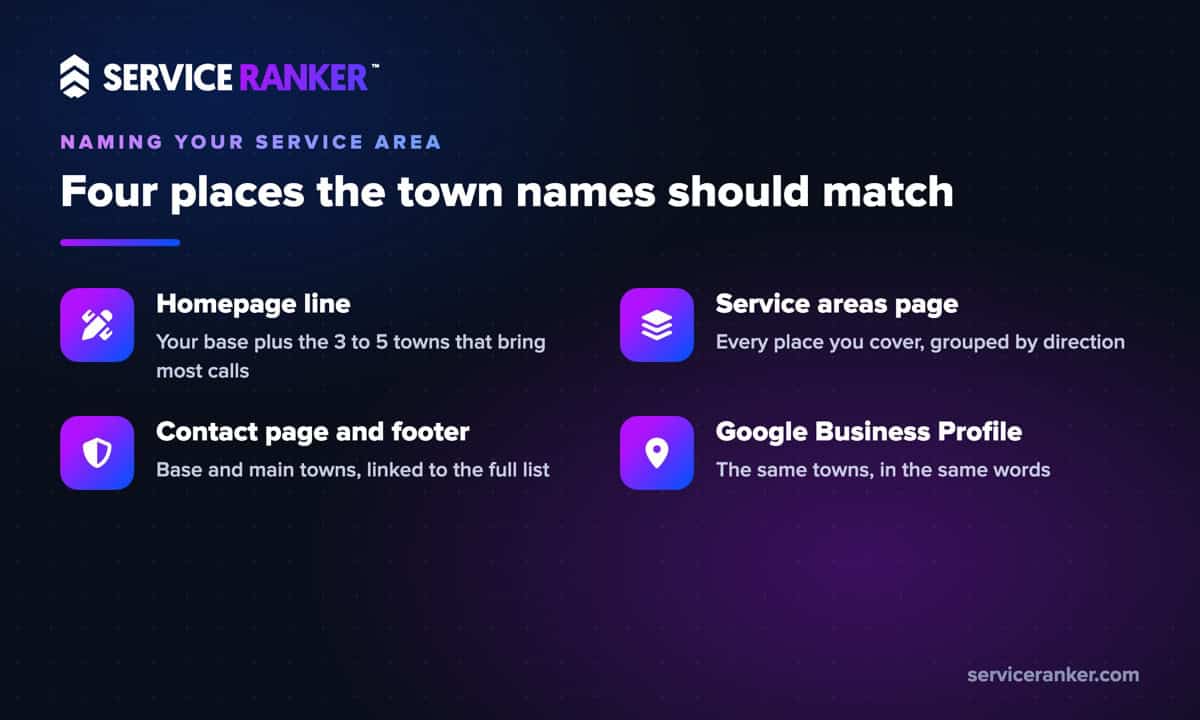
Your Google Business Profile has its own service area list. Google allows up to 20 service areas, set by city, ZIP code or other area, so there is room to list the same towns your website names. Use the town names as they appear on your site, and update both lists together when you start or stop covering a place.
The contact page and footer are the last two spots. A footer that lists thirty towns in tiny type does not help anyone. Use the footer for your base and your main towns, and point to the service areas page for the rest. Same names, same spelling, same order, everywhere.
Read your site like a new neighbor in Buda would
The quickest test is to read your own homepage as someone who just moved into a new subdivision off FM 967 or Turnersville Road. Can they tell at a glance whether you serve their street? Does the town they call home appear anywhere, in the words they would use? If the answer is no, the fix is usually a few sentences, not a new website.
Then ask a few customers in different parts of your area how they describe where they live. Their answers are your service area copy. Write down the names they use, not the names on the map. Put those names in your homepage line, your service areas page and your Google profile, and recheck them whenever you add a town.
A Buda trade does not need to sound like it covers the whole state. It needs to sound like it knows exactly where its trucks go. If you would rather hand the wording and the pages to someone local, talk with us about your website, right here in Buda. You run the jobs, we keep the calls coming.