
The report shows up on the first of the month. Fourteen pages of charts, a keyword list that scrolls forever and a traffic line that went up a little. You read it twice and still can’t answer the only question you care about: is SEO bringing in work? If that sounds familiar, the problem is usually the report, not you. Most advice on SEO reporting is written for agencies building a client report, not for the owner who has to read it.
So what should be in an SEO report for a home service business? Four numbers you can tie to the phone: calls and form leads from search, the actions people take on your Google Business Profile, how visible you are for the searches that pay, and a plain record of the work done and what comes next. Each one should sit next to the same month last year. Everything else is supporting detail.
The 4 numbers every monthly SEO report should show
A monthly SEO report for a home service owner should lead with four things: calls and form leads that came from search, Google Business Profile actions like call taps and website clicks, rankings and search visibility for your money services in the towns you serve, and the work completed this month with next month’s plan. Those four answer whether SEO is producing opportunities, and why.
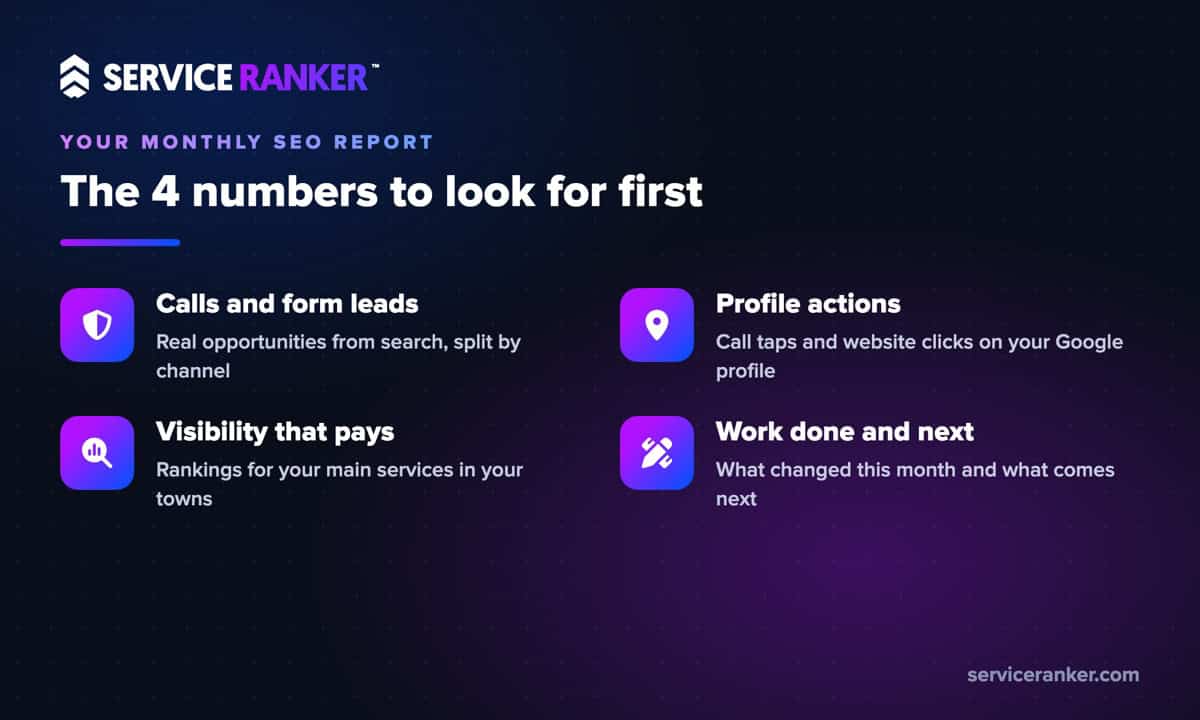
Notice what is not on that list. Total traffic, a count of every keyword you rank for and colorful scores from SEO tools can all live further back in the report. The first page should read like a call log, not a science project. If you only had two minutes, the top of the report should tell you whether more of the right people found you and reached out.
Calls and form leads from search, counted honestly
The number that matters most is how many real calls and form leads came from search this month, split by where they came from: your Google Business Profile, your website from regular search results, paid ads if you run them, and AI tools where the source is visible. That split tells you which channel is doing the work and which one needs attention. Calls usually come from call tracking numbers, and form leads from form submissions recorded in Google Analytics or your website’s form tool.
Counted honestly means filtered. Spam calls, robocalls, vendors selling you something and existing customers calling about an invoice are not new opportunities, and they inflate the total. A report that counts every ring is grading itself on a curve. Ask how calls are tracked, how forms are counted and what gets thrown out.
This is the first line in the reports we send our own clients: calls and form leads by channel. It keeps everyone honest about what marketing actually controls. Our job is to bring in qualified calls and forms. Turning those opportunities into jobs is your team’s job, so a good report shows the handoff point clearly instead of claiming credit for work it didn’t do.
Google Business Profile performance, read the right way
Your Google Business Profile performance view counts calls, website clicks and direction requests. Google defines Calls as the number of times a customer clicked on the call button on your Business Profile, so a tap is not the same as a connected call. Your report should show profile call taps next to tracked calls so you can see the gap.
For most trades, direction requests matter less, since you go to the customer. Website clicks matter more, because they feed the form and call numbers above. If profile views climb while call taps stay flat, that is a different problem with its own fixes, which we walked through in why a Google Business Profile gets seen but the phone stays quiet.
Keyword rankings and organic visibility for the jobs that pay
Keyword rankings belong in SEO reports, but only for a short list of searches that bring in money: your main services paired with the towns you actually serve, like water heater replacement in each of your core towns. Ten to twenty of those, checked from a few spots around your service area, tell you far more than three hundred tracked keywords.
The second half is search visibility from Google Search Console, Google’s free report for your website. For your service pages, look at clicks, which are the organic traffic you got from Google, and impressions, which count how often you showed up. Be careful with the single “average position” number. Google says it is the topmost position of your site, averaged across all queries, so one site-wide figure blends your money searches with every odd search you appear for. Ask for position by service page, not one blended number.
Good SEO work measured by the searches that bring in jobs should make these numbers easy to connect: the service page that moved up, the clicks it gained and the calls that followed. When those three line up month after month, the work is paying off.
Compare the data to the same month last year, not last month
Most home service work is seasonal, so a report that only compares this month to last month can mislead you in both directions. Many HVAC companies see calls fall between the summer peak and the first cold snap, no matter how good the SEO is. A pest control company’s spring jump is not all marketing either. The useful comparison is this October against last October.
The data for that comparison is usually there. Google notes that Search Console keeps data for the last 16 months, which covers a full year plus a few extra months. Your call tracking and form records should go back at least as far. If your report doesn’t show a year-over-year column, ask for one. If SEO is new, set expectations by milestone instead, the way we laid out in how long SEO takes for a home service business.
Traffic and keyword metrics that look busy but say little
Some metrics fill pages without telling you much about the business, and volume of data is not the same as insight. Total website traffic includes people looking for jobs, vendors, your own staff and visitors from three states away. A list of hundreds of keywords looks impressive, but most of them will never send a customer. Impressions alone can rise because you showed up for searches nobody in your area makes.
None of these numbers are useless. They help your SEO company diagnose problems, and they often move before calls do. They just should not be the headline. If the first page of the report is all traffic and keyword counts, ask where the calls went. A report built around activity instead of results makes it hard to tell good work from busy work.
The work log and what happens next
The fourth number is not really a number. It is a plain list of what was done this month and what is planned for next month: content written or improved, profile updates, fixes made and reviews requested, with a short analysis of why each one was chosen. Google’s own advice on hiring an SEO suggests asking whether they will share all the changes they make to your site and explain the reasoning behind their recommendations.
That list is how you connect effort to results over time. If a new service page went live in March, you should be able to see its clicks and calls in May. No work log means no way to know what earned the result. It also gives you something specific to ask about on a call, instead of nodding along to charts.
What to ask when a number drops
Every report has down months, and an honest one says so. A drop you hear about first from your SEO company is a good sign. When calls or visibility fall, ask three things. Is the drop seasonal, based on the same month last year? Is it one service or town, or everything at once? And what is the plan to fix it, with a date to check back? A good SEO company answers those plainly. Remember that Google also says no one can guarantee a number one ranking, so be wary of anyone who explains every dip away with a promise.
Once a report covers these four numbers and the questions behind them, a monthly read takes ten minutes instead of an hour. You’ll know whether search is sending more of the right calls and forms, and you’ll know what’s being done about it. If you want reporting that starts with your phone instead of a traffic chart, talk with us about SEO that reports in calls and leads. You run the jobs, we keep the calls coming.