
Picture where a tow call actually starts. A pickup loses its transmission half a mile past an exit ramp. A minivan won’t turn over in a big box store lot off the frontage road. The driver grabs a phone, types “tow truck near me,” and Google sorts the answers by how close each business is to that phone, not by which city name sits on your website. If your towing company SEO is built only around town names, it is aimed at the wrong map.
So how should a towing company do SEO to get more calls? By organizing its search presence around the roads its trucks work. That means three moves: draw your Google Business Profile service area along the routes you run, build a website page for each stretch of road you genuinely cover, and fill those pages with proof from that road. Then track where the calls start, so you know it is working.
Local SEO for towing companies starts with the road, not the city
Google says distance is one of the main inputs for local results, and it defines distance as how far each business is from the customer who’s searching. If the customer doesn’t share where they are, Google uses what it knows about their location. For most trades, that location is a house. For a tow company, it is wherever the car quit.
And a lot of driving is packed onto a small slice of road. In 2023, Interstates made up about 1 percent of U.S. public road miles, 48,415 miles out of roughly 4.2 million, yet they carried about 26 percent of all vehicle miles traveled, according to the Federal Highway Administration. That measures travel, not breakdowns. Still, it shows where the cars are when something goes wrong, and the busiest roads in your area run through places your city pages never mention.
Town pages still matter. Customers search by town, and search engines need to know which towns you serve. The trouble starts when town pages are the whole local SEO plan. A driver stuck at an interchange between two towns does not care which one owns the ramp. Your search presence should follow the same roads your trucks do.
Draw your Google Business Profile around the routes you run
Your free Google Business Profile lets you list up to 20 service areas, and Google says the overall boundary shouldn’t be more than about 2 hours of driving time from where your business is based. Most towing companies meet the customer at the vehicle, so Google’s guidelines tell them to hide the yard address and show only the area they cover.
Use those 20 slots on purpose. Skip the biggest towns on the map. Trace the corridors your trucks cover and choose the towns and ZIP codes strung along them. If your trucks run 30 minutes up the interstate but barely 10 minutes into the hills, your service area should look like that: a long shape that follows the highway, not a neat circle around the yard. An honest service area beats a big one, because a driver who waits 90 minutes outside it tends to leave the review that hurts.
The rest of the profile basics, from 24 hour availability to truck photos and the service list, are covered in why the first tow truck a stranded driver finds wins the job. Get those right first, then build the corridor work on top.
Build website pages for the stretches you work
A corridor page is a page on your website about one stretch of road your trucks cover, such as an interstate between two exits or a state highway between two towns. It should hold four things a generic town page leaves out: the road and the stretch, the exits and landmarks along it, where your truck usually waits, and the vehicles you can handle there.
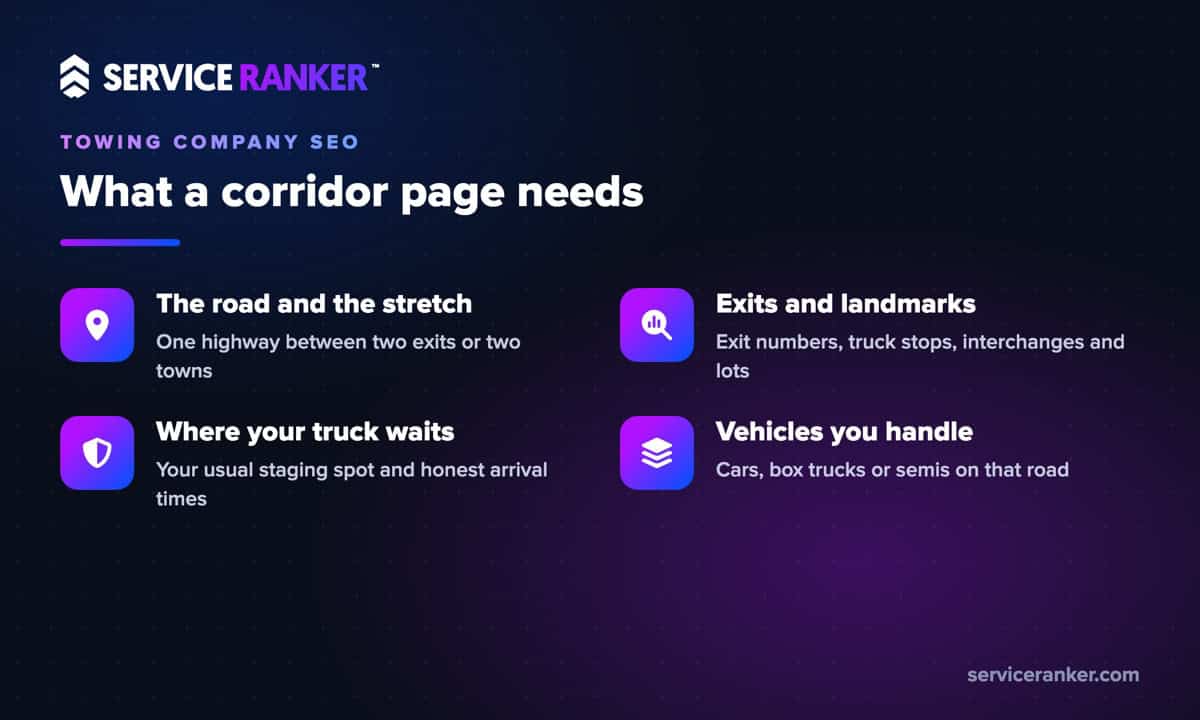
A page about a 25 mile stretch of interstate names the exit numbers, the truck stop, the interchange where wrecks back up traffic and the shopping center lots right off the frontage road. It says plainly where your nearest truck usually stages and what that means for arrival time. If semis and box trucks use that road, it says whether you run heavy duty equipment or call a partner who does. It lists the towing services you offer there, from emergency towing and roadside assistance to winch-outs and flatbed tows.
That detail does two jobs. It gives Google a page that matches what a driver on that road is searching for, and it tells the driver they found someone who knows the area. Write the content the way your dispatcher would explain the route to a new driver. Corridor pages sit alongside your service pages and town pages, not in place of them. It is the same approach we use when we build search and map visibility for tow operators: one clear page for each thing you do, each town you serve and each road you really work.
Make each corridor page true of only one road
Corridor pages have one trap, and Google names it. Its spam policies treat near-copy location pages as doorways, and sites that break those policies can rank lower or drop out of results. Twenty copies of one page with only the highway number swapped fit that description.
So run one test on every corridor page: could this page be true of any other road? If you can swap the highway number and nothing else breaks, the page is not finished. The same test limits how many you build. Start with the two or three corridors that produce the most calls today. A handful of strong pages beats a pile of thin ones, and they are far easier to keep accurate when you move a truck or add a route.
Fill each page with proof from that road
Proof on a corridor page should come from that corridor. A photo of your flatbed loading a car at the exit the page talks about says more than a paragraph of copy. So does a short note about a winch-out you did off that same shoulder last winter, written plainly and without customer details.
Reviews work the same way. You can’t script them, and you shouldn’t try. But when you text a review link after the job, it is fair to add a line like “it helps other drivers if you mention where we picked you up.” Over time, reviews that name real exits and lots read like local proof to the next stranded driver. Post the same job photos to your Google Business Profile so the profile and the page tell one story.
Track which roads the calls come from
You can’t tell whether towing SEO is working unless your tickets record where each job was. Add two fields to every call: the exit, mile marker or lot, and how the customer found you, whether that was the profile, the website, ads, a motor club or a repeat account. It takes ten seconds per ticket and ends a lot of guessing.
In the towing work we do, this is where owners get surprised. Once tickets carry a location, calls usually bunch up around a few interchanges and lots instead of spreading evenly across the towns painted on the truck door. Those clusters tell you which corridor pages to build first and which ones need work. It is the same source tagging we suggest in getting off the motor club treadmill, applied to roads instead of channels.
Then check it monthly. Your Google Business Profile reports calls made from the listing, and your website can count calls from each page. If a corridor page is live and calls from that stretch are climbing, keep going. If not, add more road detail, job photos and reviews from that stretch.
What tow companies should skip to keep their listing
Two shortcuts tempt a towing business more than most trades. The first is renting a mailbox or office near a busy interchange to get a second map listing. Google’s Business Profile guidelines say a rented address you don’t operate from, also known as a virtual office, isn’t eligible, and mailboxes at remote locations aren’t acceptable either. The second is stuffing the business name, like tacking “24 Hour Towing I-35” onto your real name. The same guidelines say service information can’t be part of the business name. Both shortcuts put at risk the one listing you can’t afford to lose.
Towing company SEO done this way is not complicated. Draw the service area along your routes, give each real corridor its own useful page, fill it with proof from that road and track where the calls start. Your trucks already know where the work is. Your website should too. If you’d like a hand building it, we can help your tow company show up along the roads you cover. You run the jobs, we keep the calls coming.