
The first cold night of the year, a homeowner hears scratching inside the kitchen wall. By morning they’re searching for a mouse exterminator near them, and Google has to decide which pest control company to show. If rodents only appear on your website as one bullet on a general pest page, there isn’t much for Google to match, and the call goes to a pest control company that spelled it out.
That’s the core of rodent control SEO. University of California pest experts note that house mice frequently enter homes in autumn when nighttime temperatures become colder. The calls follow the cold, and the cold is on a schedule. The pest control companies that get those calls have three things live by October: a dedicated rodent page, rodent control listed on their Google Business Profile, and a few plain answers to the questions homeowners ask in winter.
Rodent calls climb as other pest control calls fade
Rodent work is the part of pest control that picks up just as everything else slows down. Ant, mosquito and wasp activity drops off as the weather cools. Mice head the other way, toward warm walls, attics and garages. The same UC IPM guide says mice can get in through openings as small as 1/4 inch, so a gap around a pipe or under a garage door can be enough.
In the pest control accounts we work with, we see the call mix shift this way every year. Rodent calls climb in late fall while general pest calls fade. For a company that wants steady work through winter, that shift is the opportunity.
Rodent jobs also tend to be more than one visit. An inspection, sealing entry points, setting traps and coming back to check them all take a tech’s time. A homeowner who finds a dropping in the pantry wants someone in the house this week, and in our experience they don’t shop around for long once they find a company that clearly does this work.
A bullet on your pest control website is not a rodent page
Google matches pages to the words people search, and a list of pests on a general page gives it very little to work with. Google’s own SEO Starter Guide tells site owners to think about the words that a user might search for to find a piece of your content, and it points out that people who know a topic search differently than people who are new to it.
That’s exactly what happens with rodents. A homeowner types mice in walls, rats in the attic, mouse exterminator or rodent control near me. A property manager types commercial rodent control. Your general pest page, with “rodents” sitting between “spiders” and “roaches,” can’t speak to all of them.
When we build service pages for pest control companies, this is one of the most common gaps we find. Rodents are listed, but never explained. The fix isn’t stuffing the word mice into every paragraph. The same Google guide says keyword stuffing is against its spam policies. The fix is a real page about the work, written in the words customers use, so those keywords show up naturally. Think of it as pest control SEO for one service line, done before its season.
The content and services a rodent page needs to cover
A good rodent control page answers the questions a worried homeowner has before they call, and it shows Google that rodents are a real service line. It doesn’t need to be long. It needs to be specific. These are the four sections we build into a rodent page.
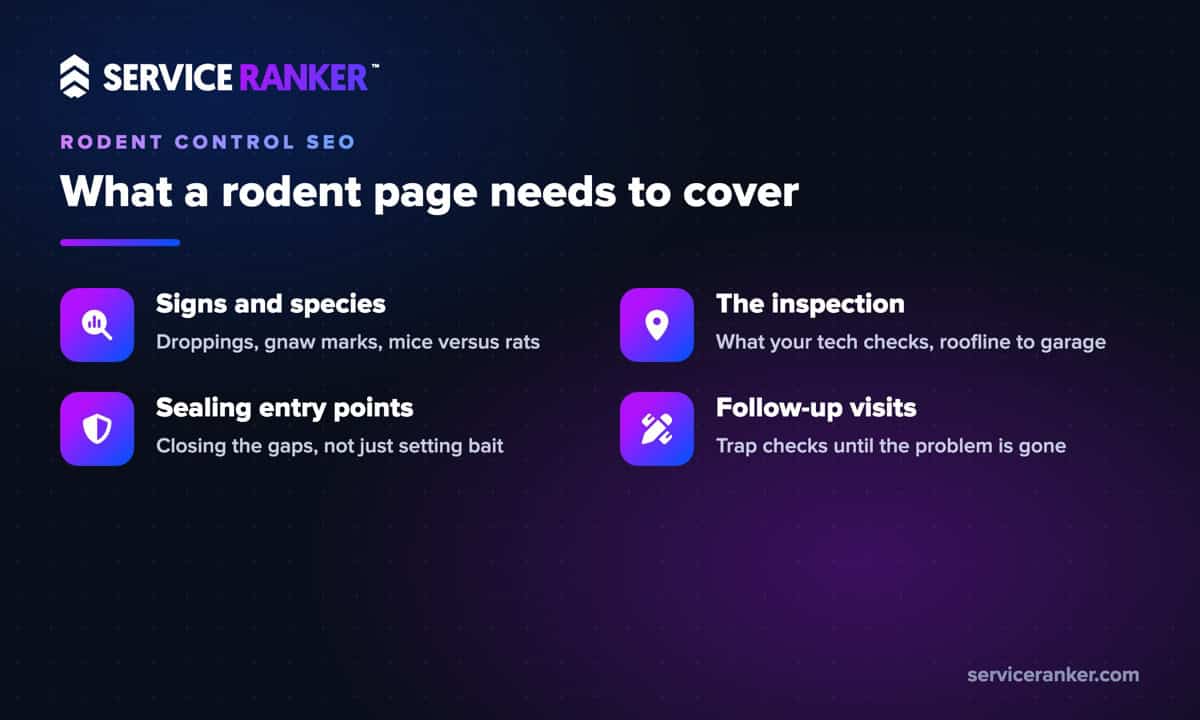
- Signs and species. Droppings, gnaw marks, scratching at night, and how mice and rats differ.
- The inspection. What your tech checks, from the roofline to the garage door.
- Sealing entry points. How you close gaps and why that matters more than bait alone.
- Follow-up visits. Trap checks, and how you confirm the problem is gone.
Round it out with the towns you serve, real photos of your own exclusion work, and a short section on commercial rodent control if you offer it. Restaurants, warehouses and apartment complexes search differently than homeowners, and a few lines for them can bring in steady accounts. Give the page a clear call button near the top, because the person reading it is often on a phone.
If you’d rather have someone build and maintain these pages, it’s a core part of the marketing we run for pest control companies, alongside the profile and content work below.
Add rodent control to your Google Business Profile
Your Google Business Profile should list rodent control as a service, not leave it implied. Google says that when local customers search Google for an offering you provide, that service may be highlighted on your profile. You can pick suggested services or add your own, with a short description for each.
Add rodent control, and if they fit your work, separate services for mouse control, rat control and rodent exclusion. Keep your categories tight, though. Google’s category guide says not to select a category for every product or service, so rodents belong in your services list, under a pest control category.
Then give the profile proof. Post photos of sealed vents and exclusion work, and ask happy rodent customers for a review. A customer describing the mice in their attic in their own words does more for your local SEO than anything you write about yourself.
Publish rodent content before the first cold snap, not after it
A rodent page published the week the calls start is already late. Google says crawling can take anywhere from a few days to a few weeks, and Google’s starter guide suggests waiting a few weeks before judging whether a change helped. October work catches November calls. November work mostly catches next year’s.
So treat rodent season like any other seasonal push. Build or refresh the page in September or early October. Request indexing in Search Console once it’s live. If you already have a rodent page from last year, update it with new photos, current service towns and anything that changed in how you do the work, so it doesn’t sit stale through the busiest stretch.
Use local content to answer the winter questions homeowners search
Supporting content gives the rodent page more ways to be found, in search engines and in the AI answers that pull from them. Homeowners ask very specific questions once the weather turns, and each one is a chance to show you know the work.
Good examples are why mice show up in walls at night, whether rats in the attic will leave on their own, whether mice leave in spring, and what draws rodents inside in winter. Answer them in short blog posts or as a question section on the rodent page itself. Keep every answer honest and practical, and link each one back to the rodent page so the content works as a group.
Where you aim that content matters too. A rodent page that ranks in a town your trucks never visit won’t fill a route. If you haven’t picked your target towns yet, start with how route density should shape pest control SEO.
How pest control companies tell if rodent control SEO is working
Look for three signals between October and January, and judge the results by calls, not traffic. First, in Search Console, filter your search queries for mice, mouse, rat and rodent. Those impressions should climb as the weather cools, which tells you the local SEO work is reaching the right searches. Second, check that the rodent page itself is collecting those impressions, not your homepage or general pest page.
Third, tag rodent calls in your call tracking so you can count them by month and by source. Rankings only matter if the phone rings with rodent jobs your pest control business wants. And when those calls come in, the company that answers fastest often wins, which we covered in how to catch the calls when people spot a pest.
The rodent season shows up on the same weeks every year. Build the page, list the service, answer the winter questions, and give Google time to find it before the first cold night. If you want help getting it in place this year, talk with us about your pest control company. You run the jobs, we keep the calls coming.