
Most pest control SEO advice starts with a keyword list. Rank for ant control, termite treatment, bed bug removal and every town name within an hour of the shop. So an owner ranks for bed bug treatment in a city 50 minutes away, the call comes in, and a tech spends half a morning driving to a one-time job. Meanwhile, the streets right next to Tuesday’s route never hear from you.
So what is the best SEO strategy for a pest control company? Aim your rankings at the towns your trucks already run, the pests that turn into recurring plans, and the pages that prove you work those neighborhoods. Keywords still matter. They just come after the route map, not before it.
Why route density beats search volume in pest control SEO
Route density is how many stops your techs make for every mile they drive, and it decides what a ranking is actually worth. A new customer on an existing route day costs a few extra minutes. The same customer across the county costs an hour of windshield time. None of that shows up in a keyword report.
That gap gets bigger with recurring service. A quarterly account isn’t one drive. It’s 4 drives a year, every year the customer stays. Put that account on a street your tech already passes on Thursday and it slots right in. Put it 40 minutes past your last stop and you’ve signed up to make that trip again and again.
So the same keyword can be worth very different amounts depending on where the call lands. A smaller town on your route can beat a bigger city off it.
Local SEO already rewards the company close by
Google’s local results already lean toward the nearby business. Google says local results “are mainly based on relevance, distance, and popularity,” and that distance “refers to how far each business is from the customer who’s searching” (Google Business Profile Help). If a customer doesn’t share where they are, Google uses what it knows about their location. Either way, your map pack position is naturally strongest close to where you’re based.
That’s good news for route-first local SEO, because the towns you already serve every week are where Google is most willing to show you. Chasing a big city an hour away means fighting the distance factor against companies based there, and any jobs you win land far from your routes.
Relevance and popularity are the parts you control. Relevance comes from a complete profile and content that matches what customers search for. Popularity comes from reviews and how well known you are in an area. Both are easier to build in towns where your trucks show up every week.
Pick your towns from the route map, not a keyword tool
The towns to target first are the ones your techs already drive through, plus the gaps between them. You can find both with records you already keep. This is the four-step process we use when we plan SEO for pest control businesses.
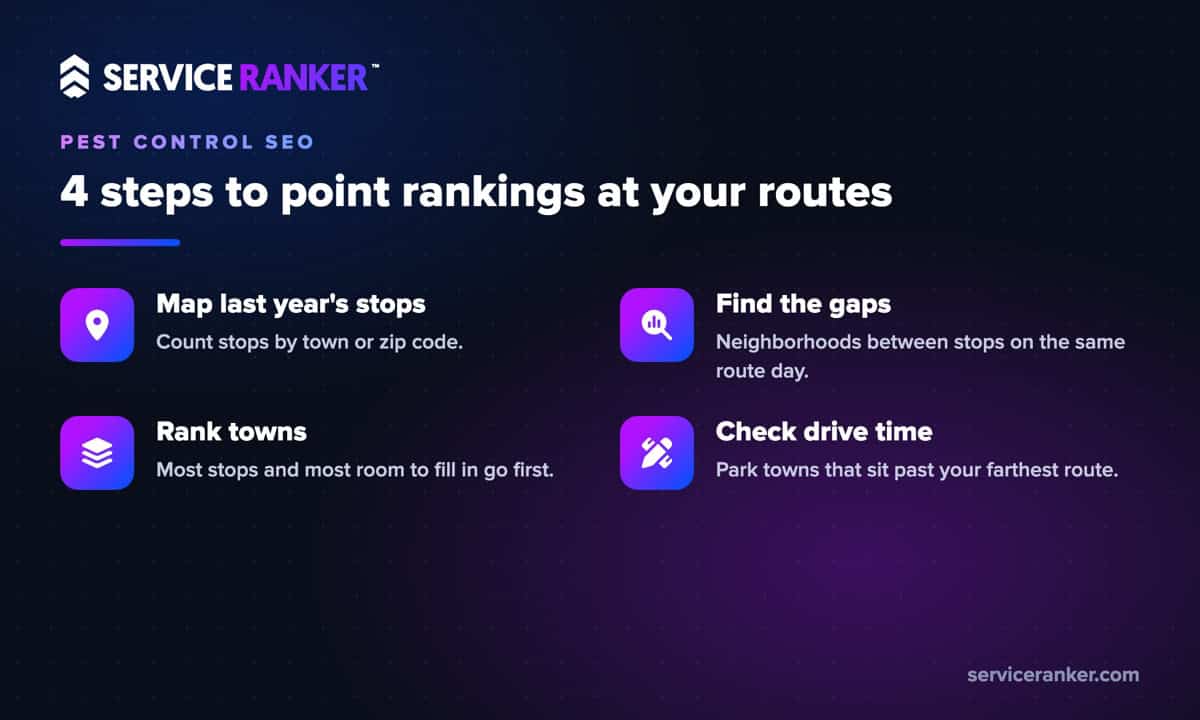
- Map last year’s stops. Export service addresses from your scheduling software and count stops by town or zip code. That’s your real service area, whatever your website says.
- Find the gaps. Look for neighborhoods sitting between existing stops on the same route day. A new customer there adds almost no drive time.
- Rank towns by stops and gaps. Towns with the most stops and the most room to fill in go first. Towns you visit once a month for a single account go last.
- Check it against drive time. If a town looks great on paper but sits past your farthest route, park it until you have a tech based closer.
Search volume shows up last, if at all. A keyword tool can tell you a city gets more pest control searches. It can’t tell you whether a job there makes your Tuesday better or worse.
Choose the pests that turn into recurring plans
Pest control companies should build pages first for the pests that lead to recurring service, then add one-off jobs inside route towns. Not every pest page earns the same. Recurring work is what makes route density pay, because each new plan adds stops your techs will run all year.
- General pest plans. Ants, spiders, roaches and the rest, usually sold as quarterly service. This is the backbone of most routes.
- Mosquito programs. Repeat visits through the season, in the same neighborhoods, and they cluster well because neighbors notice.
- Termite work. Inspections, treatment and ongoing monitoring that can keep an account on the books for years.
- Rodent exclusion. The first visit plus follow-up checks, often the door into a general pest plan.
Commercial pest accounts, like restaurants and warehouses, usually need more frequent visits than homes and deserve a page of their own if you sell that work. One-off jobs still matter. A wasp nest or a bed bug job can be good money, so rank for them in towns where the job fits a route day.
Timing matters too. Homeowners often find termites when the swarmers show up, and University of Kentucky entomologists note that “spring typically is when large numbers of winged termites, known as ‘swarmers,’ emerge inside homes” (University of Kentucky Entomology). Google needs time to find and rank new content, so seasonal pest pages like termite treatment should be live well before spring, not built the week the swarm calls start.
Build pages that prove you work the neighborhood
Pages are where pest control SEO turns into calls, and a route-town page should prove to customers and Google that your trucks run that town every week. That means route-day detail, jobs you’ve done there, reviews from customers who live there, and local pest pressure stated only when it’s true.
Build service pages for each recurring pest control service, then link town pages and pest pages to each other. The page for a route town can point to your mosquito program and general pest plan and explain what those visits look like on that side of town. The pest pages can list the route towns where you run them. That web of pages tells Google what you do and where you do it, which covers relevance from both directions.
Skip copy-paste town pages for places you rarely visit. This route-first page plan is how we approach local SEO and marketing for pest control companies, because pages tied to real routes keep paying off season after season.
Set your Google Business Profile to match the routes
For pest control SEO, your Google Business Profile service areas should list your route towns, not a big circle drawn around the shop. Google lets you list up to 20 service areas and says the overall area shouldn’t be more than about 2 hours of driving time from where your business is based (Google Business Profile Help). A tight route list is usually much smaller than that, and that’s fine.
Reviews are the other half. Google’s ranking guidance says “more reviews and positive ratings can help your business’s local ranking,” and a review from a customer in a route town is proof right where you want to rank. Ask on route days, right after a smooth visit, while the tech is still in the driveway. Those reviews also help you keep the accounts you already won, since pest control routes quietly shrink in year two when customers stop seeing the value.
Use real photos of your trucks in route neighborhoods, and keep the profile’s services list matched to the recurring pests you put first on the website.
How to tell if your rankings are filling your routes
The real test of pest control SEO is whether new customers land on your routes, not how many keywords you rank for. You can check that with three simple habits each month.
First, tag every new call and form lead with the town it came from, and compare that list against your route map. Second, watch the drive time each new stop adds. If it’s dropping, your rankings are working in the right places. Third, check Google Search Console for the searches that bring people to each town page, so you know which towns are pulling their weight and which pages need more local proof.
Rankings in towns you never visit look nice in a report and do nothing for your routes. Rankings that fill gaps on existing route days are the ones that add margin. Those route towns are also where to be first when pest control leads spike the second someone spots a bug.
Your routes already tell you where to rank. If you want a hand turning that map into pages, reviews and a profile that bring in calls from the right streets, see how we help pest control companies get found. You run the routes, we keep the calls coming.