
Your website report shows visitors. Search Console shows people finding you on Google. And the phone is quiet. If you have caught yourself asking “why is my website not getting leads,” the answer is almost always one of two things: the wrong people are visiting, or the right people are landing and leaving before they call.
That second problem happens fast. Nielsen Norman Group’s research on how long people stay on web pages found that the first 10 seconds of a visit are critical to whether someone stays or leaves. A homeowner with water on the floor has even less patience than that. Here is how to tell which problem you have, and what to fix first.
Traffic without leads is one of two problems
Check the visitors first, because a home service website can pull plenty of traffic that was never going to turn into a job:
- Out-of-area visitors. A blog post about clearing a drain can rank in states you will never drive to.
- Research-only readers. Someone looking up how termites swarm is learning, not hiring.
- Job seekers and vendors, who were never buyers at all.
Google’s Search Console Performance report shows which queries and which countries bring clicks and impressions to your site. Sort by clicks and read the top twenty queries. If they are how-to questions or towns you do not serve, your website is not broken. It is attracting the wrong crowd. That is a marketing and SEO problem, and the fix is content aimed at buyers in your service area.
Also make sure the site is not generating leads you never count. If your phone number is plain text and nothing tracks calls, a homeowner who dials from the page looks like a visitor who left. If most of your traffic comes from paid ads, the causes are different, and we covered them in why Google Ads clicks do not turn into calls.
If the queries are real buying searches from your towns and the phone is still quiet, the website has a conversion problem. The right person found you and decided not to call.
What homeowners check on your website in the first ten seconds
The same Nielsen Norman Group study found that people often leave web pages in 10 to 20 seconds, and that a website has to make its value clear within 10 seconds to hold anyone longer. For a home service business, value is the answer to four quick questions a homeowner asks, usually in this order: can I reach you right now, do you do my job in my town, are you a real local company, and what do other homeowners say about you?
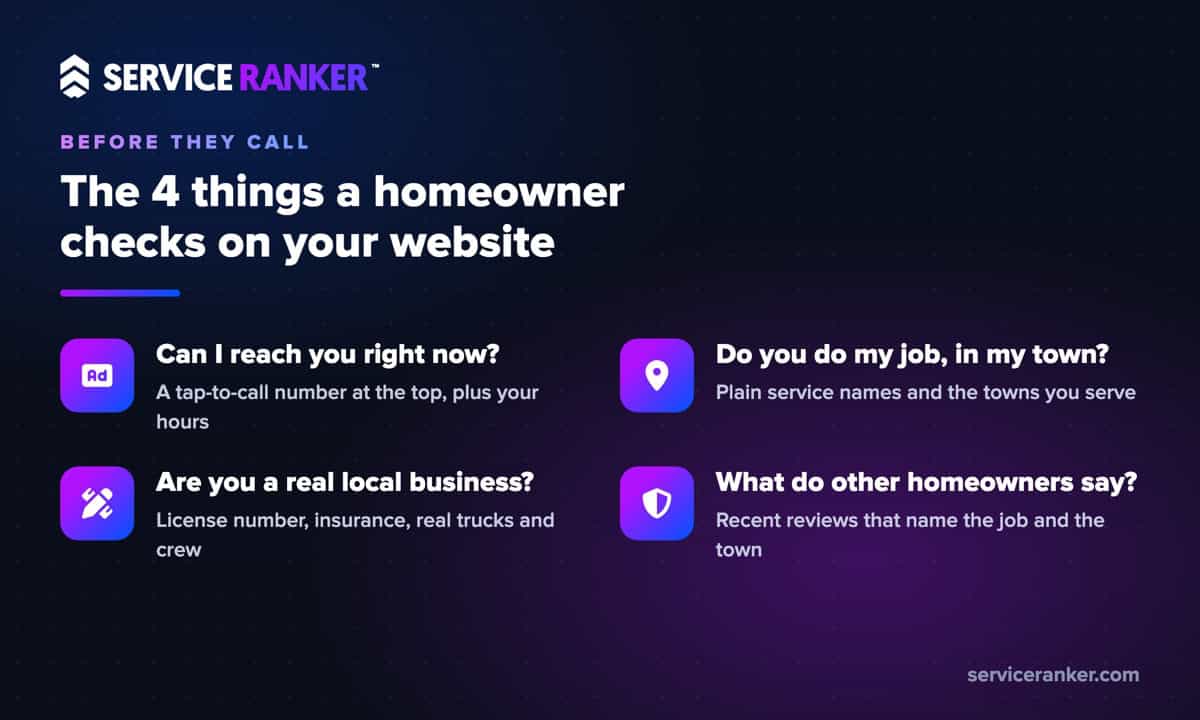
Those questions get asked on a phone. Pew Research Center found that 91% of U.S. adults own a smartphone, and a homeowner with a leak or a dead air conditioner is rarely at a desk. Your mobile visitors are standing in a hallway, scrolling with one thumb. Fail any one of the four checks and they hit the back button, and you never learn they were there.
Can I reach you right now
The first thing a homeowner looks for is a phone number, at the top of the screen. If it is not there without scrolling, plenty of them stop looking. Your phone number is the most important of your calls to action, so put it in the header on every page and make it a clear tap-to-call link, never plain text and never part of an image. A number you cannot tap is a number people have to remember, and nobody remembers a phone number in the middle of an emergency.
Next to the number, say when you answer, so a homeowner at 9 p.m. knows whether calling is worth it.
Speed is part of being reachable. Google’s guidance for site owners says a good Largest Contentful Paint is 2.5 seconds or less, meaning the biggest piece of content on the screen should appear within two and a half seconds. A contact form can still generate leads from people who are not in a hurry, but it should never be the only way to reach you.
Do you do my job, in my town
Once a homeowner knows they can reach you, they want proof they are in the right place. That takes two clear answers on the first screen: what you fix and where you work.
Use the words homeowners use. People type “water heater leaking” and “mice in the attic,” not “residential plumbing solutions.” If your homepage headline could belong to any company in any trade, it is not answering the question. Then name the towns you serve near the top. One plain line does more than a map buried on the contact page.
Where they land matters too. A homeowner who wanted drain cleaning and lands on a homepage that leads with remodeling will assume you do not do drains. Each service you want calls for deserves its own page that matches the job. Good web design for a trade starts with a website built around how homeowners actually search and call, because the page that answers the search is the page that rings the phone.
Are you a real local business
Before calling, a homeowner wants proof you are licensed, insured and actually local. The FTC’s advice on avoiding home improvement scams tells them to consider only contractors who are licensed and insured, to confirm the license with the state or county, and to search the company name alongside words like “scam” and “complaint.”
Treat the FTC’s checklist as a list of things your website should already show. If your trade is licensed in your state, put the license number in the footer and on the about page. Say you are insured. Show a real business name, the real towns you serve and, if customers can visit, a real address.
Then show real people. Photos of your trucks, your crew and finished jobs tell a homeowner this company exists and shows up. When we review home service websites, the ones that feel anonymous tend to share the same gaps: no owner name, no team photo, no license number and nothing that ties the business to a town. A phone photo of your truck in a customer’s driveway beats a polished photo of somebody else’s.
What other homeowners say about you
The last check is reviews. The same FTC guidance tells homeowners to read reviews with a critical eye. A careful homeowner looks for reviews that are recent, specific and tied to real people, and notices when every review sounds the same.
Put a few real reviews on the pages that get traffic, with the customer’s first name, their town and the job you did, and link to your Google reviews so a homeowner can check them somewhere they already trust. A review that names the job and the town does more than a wall of stars.
Do not fake it. In 2024 the FTC announced a final rule banning fake reviews and testimonials, including AI-generated ones, with civil penalties for knowing violators. A short list of honest reviews earns more calls than a long list of suspicious ones.
Test your own website and fix what you find
You can check all of this yourself in about ten minutes with your own phone.
- Get off your Wi-Fi. Switch to cell data, open a private browser tab, and search for your main service and your town.
- Count to ten from the moment the page opens. Can you see the phone number, what you fix, where you work and one sign you are a real company?
- Tap the phone number. It should open the dialer. If it does not, that is your first fix.
- Open the page for the job that pays you best. Does it exist, and does it match what a homeowner would search?
- Hand the phone to someone who has never seen your site. Ask what you do, where you work and how to reach you. Every pause is an item on your to-do list.
Fix what you find in the order a homeowner checks. Reachability comes first, because a homeowner who cannot call you cannot become a lead, no matter how good your reviews are. In the websites we review, it is common to find at least one problem in the first ten seconds, usually one the owner walks past every day because they already know their own number.
If the test turns up more than you want to tackle yourself, we can help. See how we build websites for home service companies that answer all four questions and turn more visitors into leads. You run the jobs, and we keep the calls coming.