
It’s the first cold morning of the year, and three homeowners in three states wake up to a chilly house. In Ohio, one grabs a phone and types “furnace repair.” In South Carolina, another types “heat pump not heating.” Here in Central Texas, plenty of homeowners just call it the heater and search “heater repair.” Same problem, three different searches, and the HVAC company whose website speaks the right language has the best shot at the call.
So how do HVAC companies rank for heating repair searches in their area? Build your heating pages around the equipment your market actually owns, use the words your customers use for it, and make your Google Business Profile say the same thing. That is what HVAC SEO for heating season comes down to, and most of the advice out there skips it entirely.
HVAC SEO starts with the equipment your market owns
People search for the thing in their basement, closet or yard. Federal data shows that thing changes a lot from state to state. In the U.S. Energy Information Administration’s 2020 home energy survey, a furnace was the main heating equipment in 60 percent of U.S. homes, a central heat pump in 13 percent and a boiler in 8 percent. The state numbers are where it gets interesting.
| Where | Furnace | Central heat pump | Boiler |
|---|---|---|---|
| U.S. overall | 60% | 13% | 8% |
| Ohio | 77% | 5% | 5% |
| Texas | 61% | 19% | Not reported |
| North Carolina | 50% | 38% | Not reported |
| South Carolina | 46% | 41% | Not reported |
| Florida | 33% | 31% | None reported |
| New York | 44% | 3% | 35% |
An Ohio contractor lives in furnace country. A Carolina contractor splits the work nearly down the middle between furnaces and heat pumps. A New York contractor finds boilers in about a third of homes. Those three businesses should not build the same heating pages, yet most HVAC websites use the same template no matter where they are. For HVAC contractors, the equipment mix should shape the whole content plan, from page titles to the services listed on the profile.
Find out what your customers actually call it
Google’s own SEO Starter Guide tells site owners to think about the words that a user might search for, and it notes that people with different backgrounds use different words for the same thing. Its example is charcuterie versus cheese board. In HVAC, it’s furnace versus heater versus heating system, and you already have four places to hear which one your customers use.
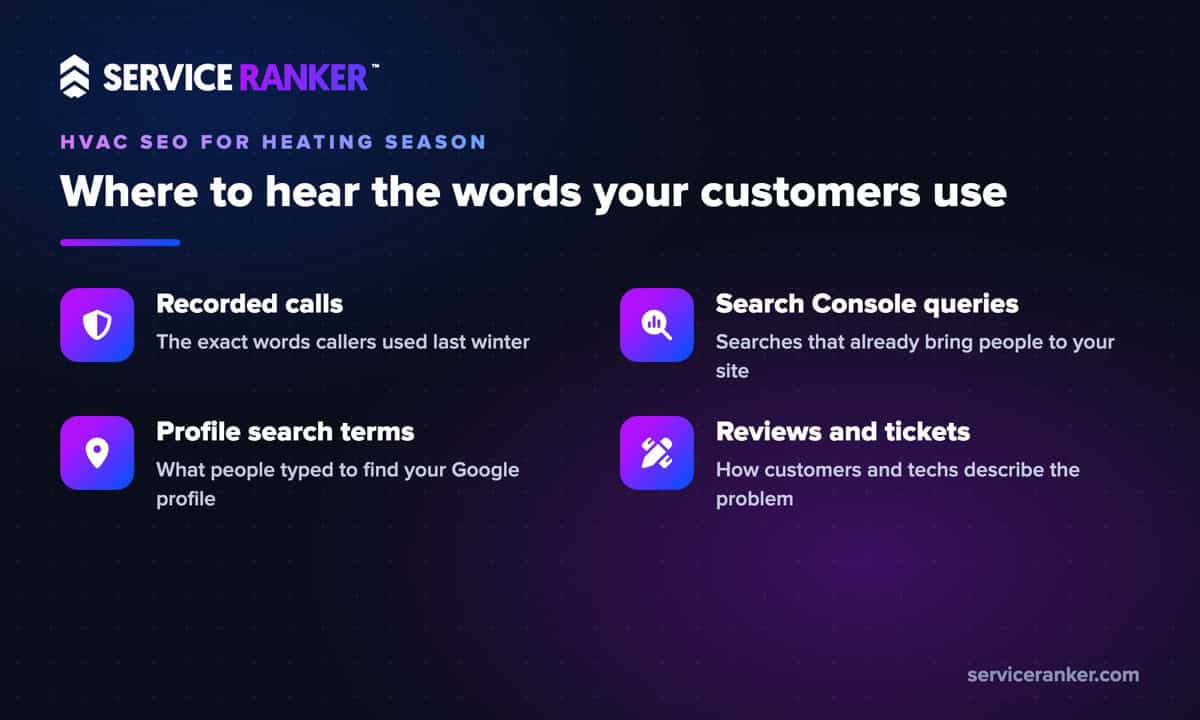
Start with your phone. Listen to a handful of recorded calls or read your intake notes from last winter and write down the exact words callers used. Then open Google Search Console, Google’s free report for your website, and look at the queries that already bring people to your site. Your Google Business Profile performance view shows the search terms people used to find your profile. Finally, read your reviews and your techs’ tickets. Customers describe the problem in their own words, and those words belong on your pages.
We do this before naming a single heating page for an HVAC client. A keyword tool can tell you how many people search a phrase nationally, but only your own callers can tell you how people in your towns talk about a cold house.
Build HVAC service pages around equipment, not one catch-all
Once you know the words, give each heating system you service its own page. Furnace repair gets one. Heat pump repair gets one. If you work on boilers, that gets one too. A single “heating services” page trying to cover all three rarely ranks well for any of them, because it can’t answer the questions each homeowner actually has. Specific content earns specific searches.
Each page should use the customer’s word in the title, the main heading and the first few lines, then cover what that homeowner needs to know: the common problems with that system, what a repair visit looks like, when replacement makes more sense and how quickly you can get there. Mention the other words naturally where they fit. A heat pump page can say “heat pump, sometimes called the heater” once without forcing it.
What you should not do is build three near-identical pages for “heater repair,” “heating repair” and “furnace repair” with the words swapped. Google’s guide warns that repeating the same words over and over is tiring for readers and that keyword stuffing is against its spam policies. One strong page per system beats a stack of synonyms. It is the same structure we use in marketing for HVAC companies built around the systems they service, with local SEO on top so each page reaches the towns you cover.
“Heater” is a word that needs a little help
Heater is the trickiest word on the list, because it means more than one thing. A homeowner typing “heater repair” might have a cold house, or they might have a water heater that quit, or a space heater that stopped working. When we looked at monthly search patterns for these terms, “heater repair” stayed busy in July, when almost nobody needs a house heated, while “furnace repair” fell off sharply after winter. That suggests a good share of heater searches are about water heaters.
That doesn’t mean you should skip the word. In markets where people say heater, it belongs on your home heating page. Just make the page clear in its first lines that it’s about heating the house, name the systems you work on, and if you also handle water heaters, link to that page so the wrong visitor finds the right one fast.
Make your Google Business Profile speak the same language
Your profile should use the same words as your pages. Google’s guidelines tell businesses to choose the fewest categories it takes to describe the core business, so let the services list do the detailed work. List furnace repair, heat pump repair and any boiler service by name, with short descriptions in your customers’ words. Keep service terms out of the business name itself, which the same guidelines don’t allow.
Reviews help here too. When you ask for a review after a heating call, a customer who writes “they fixed our heat pump the same day” adds real, local proof in the exact words other homeowners search. You can’t script reviews, but you can ask at the right moment, right after a cold house turns warm again.
Track heating calls and leads by page, not just rankings
Rankings tell you where a page shows up. They don’t tell you whether it brings in work. For every heating page, track three things through the season: clicks from Google in Search Console, calls and form leads that came from that page, and how both compare to the same weeks last winter. That is the scoreboard that matters for search engine optimization in a seasonal trade.
The pattern usually shows up fast. If the heat pump page gets visibility but few calls, the page may need clearer answers, better photos of your own installs or a more obvious phone number. If the furnace page gets calls but little traffic, it is working and deserves more support, like reviews that mention furnace work and a link from your home page. Let the calls tell you which page to improve next. HVAC contractors who check this monthly stop guessing about their marketing and start fixing the pages that are close.
Get local SEO for HVAC companies ready before the first cold snap
Timing matters as much as wording. Heating searches climb when the weather turns, and a page published the week of the first freeze is late. New and updated pages take time for Google to find and trust, so the best time to fix heating pages is early fall, while the calendar still has room. The work you do in the slow weeks is what shows up when the phone starts ringing.
If your shop has a quiet stretch between seasons, that is the window for this. We covered how to use those weeks in keeping the HVAC calendar full through the shoulder season, and heating page work fits right into that plan.
HVAC SEO for heating season does not need to be complicated. Learn what your market heats with, use the words your customers use, give each system its own clear page and match your profile to it. Speak your customers’ language and the right calls find you. If you want a hand with it, we can help your HVAC company show up for the heating searches in your area. You run the jobs, we keep the calls coming.