
Most advice on SEO for plumbers says the same thing: build a page for every town you serve. So a plumbing company adds thirty city pages to its website in a weekend, each one a copy of the last with the town name swapped out. A few months later, most of them still are not showing up anywhere. Google crawled them, looked at them, and decided they were not worth keeping.
Here is the short answer to how many city pages a plumber needs. Build one page for each town you actually work in and can say something real about. For most plumbers that is a handful, not dozens. The rest of this post covers why Google skips the copy-paste kind, what makes a service area page worth indexing, and what to do with the thin ones already on your website.
How many city pages plumbers actually need for local SEO
In SEO for plumbers, the right number is one service area page per town you truly serve and can describe in specific terms, and that number is usually smaller than owners expect. Google’s own rules for service area businesses set a useful ceiling: you can list up to 20 service areas, and the whole area should sit within about 2 hours of driving from where you are based (Google Business Profile Help).
That ceiling is not a target. A two-truck plumbing business does not have twenty towns where it can show up fast. Start with the four to eight towns that already produce most of your calls. Those are the places where you have jobs to talk about, reviews from local customers, and a response time you can stand behind.
Think of each city page as a promise. If you would not happily drive a water heater swap to that town on a Tuesday afternoon, the page should not exist. Town pages are one piece of SEO and marketing for plumbing companies, and they work best when the count follows your real dispatch area, not a list of keywords. A sound SEO strategy starts from where your trucks actually go.
Why Google skips copy-paste city pages
Google skips templated ones because its spam policies describe them almost word for word. The doorway section lists “pages targeted at specific regions or cities that funnel users to one page” and “substantially similar pages that are closer to search results than a clearly defined, browseable hierarchy” as examples of abuse (Google Search Central).
Most plumbers who build these templates are not trying to game anything. They followed plumber SEO advice from an SEO company or a website builder that treats location coverage as a numbers game. But Google cannot tell intent from the copy. It sees thirty versions of the same drain cleaning text, and it picks one or none.
We have watched this happen. On one site, Google declined to index a batch of thin, templated city pages for areas far from the business, while regular articles on the same site got indexed without trouble. Google simply crawled them and left them out of search results. That is the usual outcome: no punishment, just URLs that never get a chance to rank.
The real cost is the time spent building them and the false sense that your SEO already covers your service area.
What makes a service area page worth indexing
A service area page earns its place when a homeowner in that town learns something they would not get from your home page. That comes down to four checks. Pass all four and it reads like it was written for that town. Fail most of them and it is a template with a new name on top.
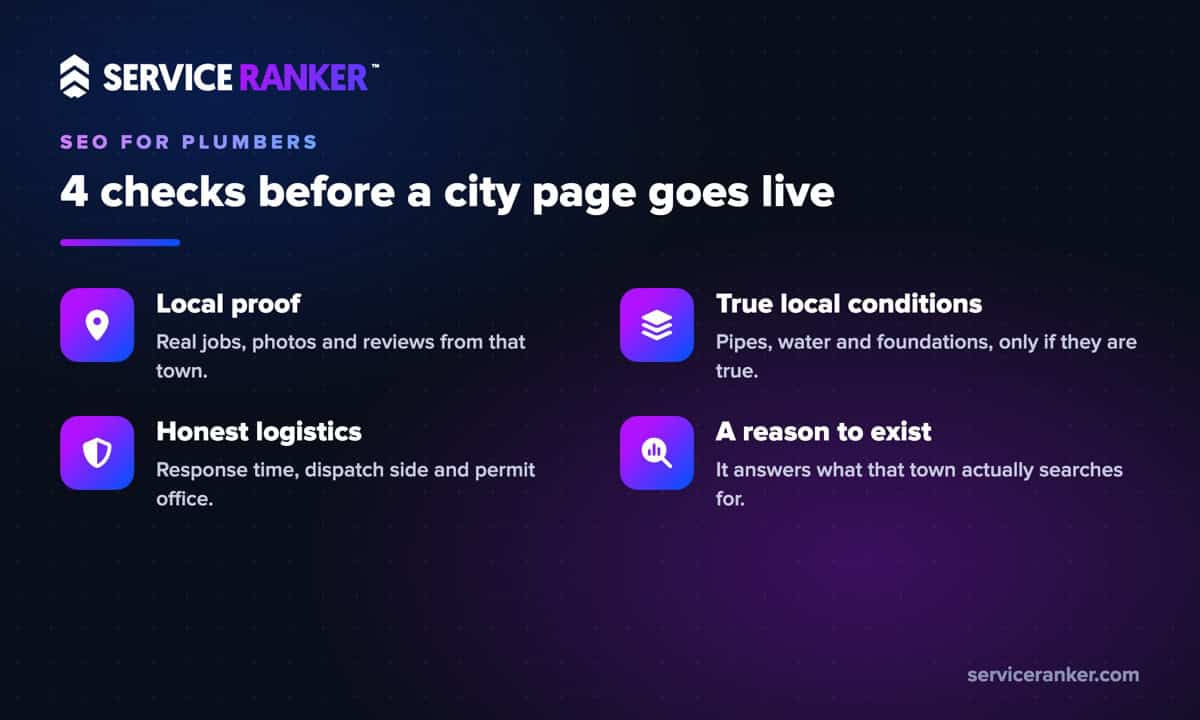
- Local proof. Jobs you have done in that town, photos from those jobs, and reviews from customers who live there.
- Local conditions, only if true. Older neighborhoods with original pipes, hard water noted in the city’s water quality report, slab foundations that lead to slab leaks. Say it only if it is true for that town.
- Honest logistics. How fast you can get there, which side of town you dispatch from, and whether permits run through that city or the county.
- A reason to exist. The page answers what someone in that town is actually searching for, such as emergency service or water heater replacement, not just “plumber in [town].”
A tight page with two real job stories and a couple of local reviews beats a long one stuffed with the town name. Specific beats long every time.
Plumbing SEO starts with service pages, not city pages
Service pages should come first because they tell Google what you do, while city pages only tell it where. Google says local results weigh relevance, distance and prominence, and relevance is “how well a Business Profile matches what someone is searching for” (Google Business Profile Help).
For a plumbing business, relevance lives on a page for each of your plumbing services: water heater repair and replacement, drain cleaning, leak detection, repiping, and sewer line work. Each one should explain the job, the signs a homeowner notices, and what happens when you show up. A city page with no service depth behind it has nothing to say, so it ends up repeating the home page. Technical SEO matters too, but no amount of technical SEO fixes a page that says nothing new.
Once the service pages exist, each city page can point to them and talk about how those jobs look in that town. That is how local SEO for plumbers holds together: strong service pages carry the what, a few honest city pages carry the where, and your Google Business Profile ties both to a real location. Search engines and potential customers read your website the same way.
Picking which towns your plumbing business covers first
The first towns to get a page are the ones where you already win work and can respond fast. Rank your candidate towns with four simple questions, in this order:
- Where do your calls and finished jobs already come from? Your call log and invoices answer this better than any keyword research tool.
- Where can you realistically arrive in under an hour for an emergency?
- Where do you already have reviews from customers who live there?
- Where is the work you want more of, such as the neighborhoods with aging water heaters or older sewer lines?
Response time matters more than most plumbers think, because emergency callers rarely shop around. A local page for a town you cannot reach quickly sets up a call you will lose anyway. Keep your Google Business Profile service area list and the towns you build for roughly matched, so the two tell Google one consistent story.
How to tell if Google is indexing your city pages
Google Search Console’s Page indexing report shows exactly which URLs Google kept and which it skipped. The status to watch reads “currently not indexed,” which Google describes as a page that “was crawled by Google but not indexed” and “may or may not be indexed in the future” (Search Console Help).
Two other statuses point straight at template problems. “Duplicate without user-selected canonical” means Google decided another of your URLs is the real version and indexed that one instead. A page listed as discovered but not indexed means Google found it but has not crawled it yet. If most of your city URLs land in these buckets, they are too similar to each other, not too few.
A quick site search on Google gives you a rough idea, but it is not reliable. Search Console is the real check for any plumbing SEO work, and it costs nothing to connect to your website.
What to do with thin pages already on your website
Thin ones you already have should be improved, merged or retired, not multiplied. Sort them into three groups. Pages for towns you serve every week get rewritten with real jobs, photos, reviews and local detail. Pages for towns you rarely reach get folded into a nearby town’s page or redirected to the closest strong page. Anything for places you do not actually serve comes down.
Whatever SEO strategy you follow, stop generating more of the same. The same Google spam policies define scaled content abuse as “many pages” generated “for the primary purpose of manipulating search rankings and not helping users.” Forty near-identical city pages fit that description, even when nobody meant harm.
Fewer, stronger ones also make your local SEO easier to keep up. Each strong city page can grow over time as you add new jobs and reviews from that town, and that steady local proof is what keeps a page indexed and climbing. If you want help sorting out which towns deserve a page and building them right, see how we market plumbing companies. You run the jobs, we keep the calls coming.