
A service business owner crossed my feed this week with a big announcement. After 20 years in their trade, they had built an app. It had AI features, a spot in a startup contest, and a link asking customers for upvotes. The comments were full of congratulations.
I did not see a launch. I saw a business quietly stepping out of its own market. And if that owner competed with you, this would be the best news your company got all year.
Shiny object syndrome is the pattern behind it, and it is worth understanding from both sides. You want to know what it looks like when a competitor catches it, because their distraction is your opening. And you want to know the early signs in yourself, because nobody is immune the day a new idea shows up wearing a business plan. Here is what the pattern looks like, what the numbers say happens next, and how a focused owner turns a rival’s side project into booked jobs.
What shiny object syndrome looks like from the outside
Shiny object syndrome is when a business owner keeps chasing the newest exciting thing, a product idea, a rebrand, a second venture, instead of finishing the work that grows the business they already have. The name comes from the way a magpie grabs at shiny objects. In business, it usually dresses up as innovation.
You can spot it in a competitor without much practice. The tells are consistent:
- A launch announcement for something outside their trade, usually software
- Contest entries and upvote requests where customer requests used to be
- Big talk about a market they have never worked a day in
- A quiet slowdown in the boring stuff: reviews, response times, follow-up
None of this makes someone a bad operator. Most owners who catch it are smart, curious, and a little bored of the grind. That is exactly what makes it dangerous. The new idea feels like growth. It is really a leak. Attention drains toward the exciting thing, and the business that pays for everything gets whatever energy is left over.
AI made this pattern much more common. It used to take real money and a development team to act on a software idea, and that barrier saved a lot of owners from themselves. Now an AI app builder will turn a shower thought into a real-looking product over a weekend. The barrier is gone. The odds have not moved.
The math on side projects is brutal
Every one of these launches believes it is the exception. The numbers say almost none of them are.
Roughly 90% of startups fail, a figure Startup Genome and years of follow-up research keep landing on. CB Insights studied 431 failed startups and found 43% died on poor product-market fit. They built something nobody needed. Two-thirds of those product-market-fit failures were early-stage companies that never found a market at all. And for apps specifically, Gartner projected that fewer than 1 in 10,000 consumer apps would ever be considered a financial success by the people who built them.
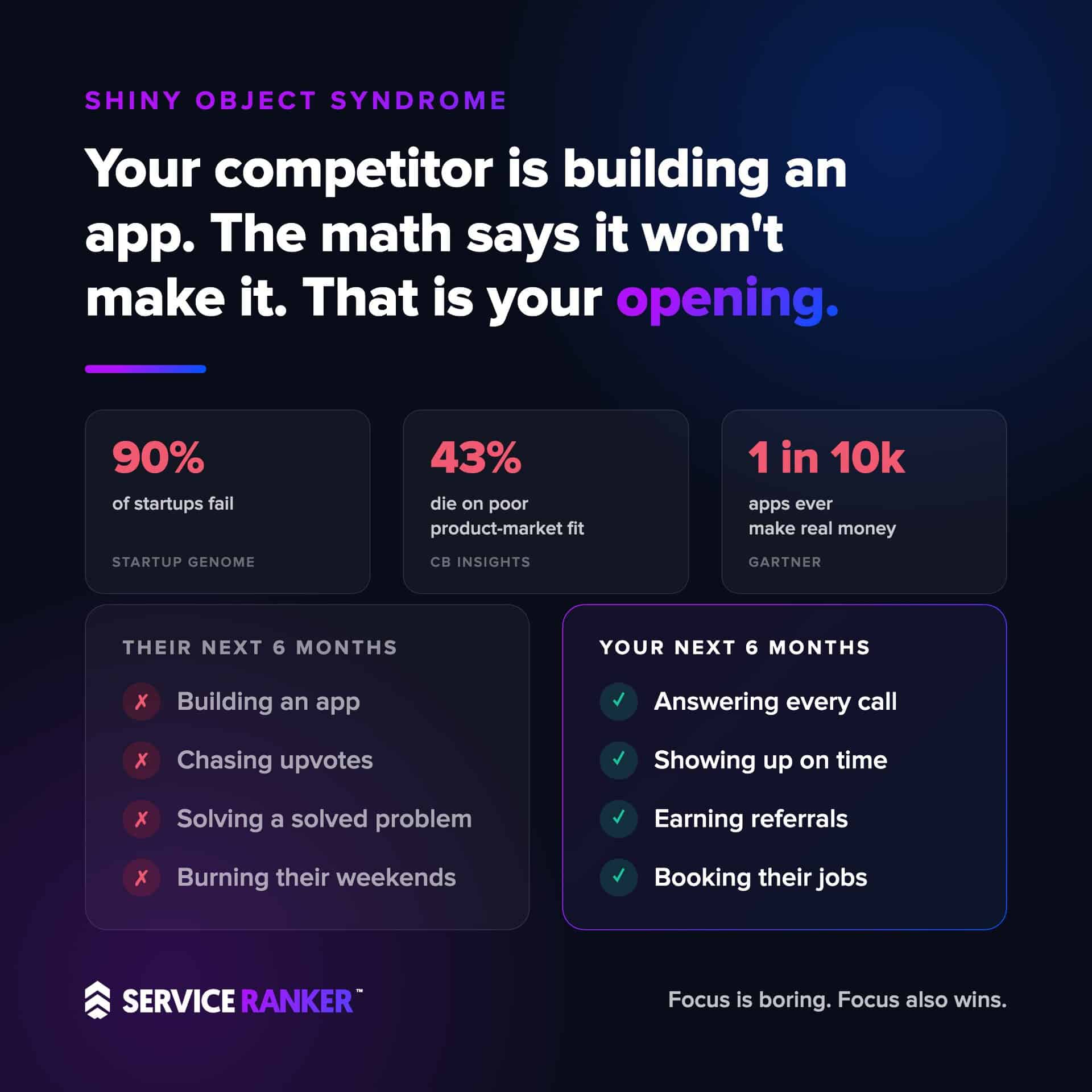
Now add the part the studies cannot measure. Those odds belong to full-time founders with funding, networks, and years to burn. A tradesperson building software on nights and weekends, in an industry they have never worked in, faces worse odds than that. Most of these products never make it past the founder’s inner circle, and the upvotes come from friends being kind, not customers reaching for their wallet.
There is one more problem, and it is the quiet killer. If an app was prompted into existence with an AI builder, anyone else can build the same thing the same way. There is no edge in it. Scheduling software already exists. Booking software already exists. The thing that could not be copied was the 20 years of trade skill and the local reputation, and that is the asset sitting on autopilot while the app gets the attention.
Every hour on the new thing comes out of the business
The app itself is not the real risk. The real risk is what the business stops doing while the owner builds it.
Running a service company well is a full-attention job. Calls need answering while the customer still has their phone in hand. Estimates need to go out the same day. Crews need checking, reviews need asking for, callbacks need making. None of it is glamorous, and all of it decides whether the schedule is full in three months.
A side project does not take its hours from nowhere. It takes them from exactly that list. The owner is heads-down in a feature checklist, so the follow-up slips. They are pitching a contest, so the estimate goes out Thursday instead of Tuesday. Every hour spent on the app is an hour handed to a competitor, and the damage compounds quietly because nothing breaks all at once. The phone does not stop ringing. It just rings a little less, for months, while somebody focused picks up the difference.
Using software to run a tighter business is smart, and buying tools that already exist is what focused owners do. Building software is a different decision entirely. It is a second full-time job in a market where you are the rookie.
Your playbook while a competitor is distracted
When a rival announces their big side project, they have told you something valuable: where their attention will be for the next year. You do not need to say a word about it. You just need to be ruthlessly good at the basics they are about to drop.
Answer every call, including the ones at 4:55 on a Friday. Show up when you said you would. Ask every happy customer for the review and the referral while the job is fresh. Get estimates out the same day. Keep your response time short enough that nobody ever needs a second option. Their distracted quarter is your best sales quarter, and none of it requires anything clever. It requires showing up while they are somewhere else.
The same logic is why focused owners hand the getting-found work to a home service marketing agency instead of adding another job to their own plate. The rankings, the reviews strategy, the ads, all of it keeps compounding while the owner stays pointed at the work. Focus is not doing everything yourself. It is making sure every hour, yours or hired, pushes the same business forward.
How to keep from catching it yourself
Nobody plans to catch shiny object syndrome, so it helps to have a test ready before the exciting pitch arrives. Here is the one we like: will this new thing book more jobs in the next 90 days? Not someday. Not after it scales. In 90 days.
A new truck wrap can pass that test. A faster quoting tool can pass it. An app for your entire industry almost never does, and the honest version of that answer usually saves an owner a year of weekends. If an idea will not book jobs in 90 days but still will not leave you alone, park it in writing. Ideas that survive six months in a notebook have earned a real conversation. Most will not survive the week, and that is the point.
The way to avoid shiny object syndrome is not to kill ambition. It is about respecting the math: the business you already own is the rare thing that actually works, with real customers, real margins, and a market you know cold. Boring focus beats exciting distraction in every trade we have ever watched, and the gap shows up in the schedule within a quarter.
So let the competitor chase the glitter, and wish them well in the comments if you like. Then go take the calls they stop answering. You run the jobs, and Service Ranker keeps the calls coming while you do.